
Most gifted
Shop now


Cart
Your cart is empty
Your gifting options
Make your gift extra special with our luxury packaging options. Select a gift bag, gift box or a combination to create the perfect presentation.

Luxury Gift Box, Gift Bag & Wrapping Kit (€8,99)

Meaning Card (€2,50)
Add more meaning to your gift with a meaning card included with your order.
15 variations available

Gift Bag, Ribbon & Wrapping (€5,99)
The full CRAFTD gifting experience.
Includes: Premium CRAFTD gift bag, Ribbon & Wrapping Paper.
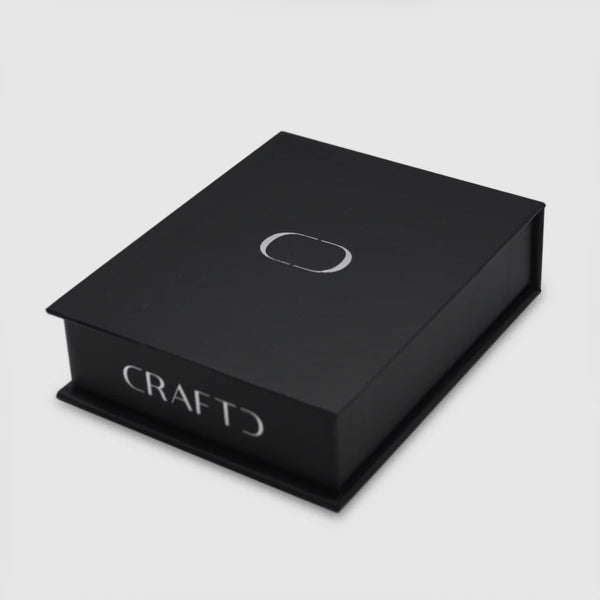
Luxury Gift Box (€5,99)
Choose your option
To My Boyfriend

To My Husband

To My Soulmate

To My Son

To My Grandson

To My Brother

To My True Friend

To My Dad

A Symbol Of Strength

A Symbol Of Faith

A Symbol Of Protection

A Symbol of Luck

A Symbol Of Safe Travel

A Symbol Of Self Belief

A Symbol Of Adventure
Article: Does Jewellery Have to Cost More to Mean More?

Ask a man which piece of jewellery he'd grab if the house was on fire, and the answer probably wouldn't be the most expensive thing he owns. It might be the thin chain he's worn since he was twenty. The ring he bought with his first proper wages. The bracelet that's been on his wrist through three jobs and more than one bad year. Ask him what it cost and he might not even remember.
So why do we still assume that the more something costs, the more it's worth? And if price isn't what gives a piece its value, what does?

Rarely the most expensive thing he owns. Always the first thing he'd grab.
The idea that expensive means valuable runs deep. In 1899, the economist Thorstein Veblen published The Theory of the Leisure Class, in which he introduced the idea of conspicuous consumption: put simply, buying things partly so other people can see what you can afford. Some things, he argued, are prized precisely because they're expensive. The price itself becomes part of their appeal.
He had a point. Price does say something. But notice who it's talking to. It can tell other people what you were prepared to spend. It says very little about what the piece means to the man wearing it. And that's where the difference between price and personal value starts to become interesting.
Sentimental value works differently. Research by Yuna Yang and Jeff Galak, published in the Journal of Personality and Social Psychology in 2015, found that sentimental value can slow down what's known as hedonic adaptation. It's the psychological process through which we gradually become accustomed to the things we own, meaning the excitement of something new eventually wears off. Their research found that possessions with sentimental associations hold on to their value in a different way. As the novelty fades, the memories and associations attached to an object can continue to make it meaningful.
And memories don't come with a receipt. They come from wearing a piece. The chain that was round your neck the day you got the job. The ring you kept turning on your finger while you waited for news. The bracelet you never took off on the trip of a lifetime.
Every year you wear something, it collects a little more of your life. That's the kind of value no price tag can add, and none can take away. It's also why we've always argued that good pieces should be worn every day, not saved for best.
Of course they do, just not for the reason people usually think. A piece can only build up meaning if it's still around to wear, so the real question isn't simply how much it cost. It's whether it's made for the way you're going to wear it. Different materials have different strengths, and understanding them helps you choose something that'll stay with you.
Sterling silver is 92.5% pure silver, which is where the familiar 925 stamp comes from. In the UK, silver articles weighing more than 7.78g generally need to carry a hallmark, subject to certain exemptions under the Hallmarking Act 1973. Wear it every day and it'll gradually pick up small marks and develop a patina. For plenty of men, that's part of the appeal. It starts to look like something that's actually been lived in, rather than something kept behind glass.

Sterling silver picks up marks that tell your story.
Our steel-core pieces use 316L stainless steel beneath a gold or rhodium finish. It's a durable, corrosion-resistant material that releases very little nickel. They're designed for everyday wear, including showers and rain, although taking them off before swimming in chlorinated pools or the sea helps protect the finish.
Gold vermeil offers another option, pairing sterling silver with a gold-plated finish. You get the warmth of gold with sterling silver underneath. If you want to compare the options properly, we've put together guides on sterling silver vs stainless steel and 18K gold vs gold vermeil.
None of these materials is automatically better than the others. The right choice comes down to how you want to wear a piece, how much care you're prepared to give it and what matters most to you. Because the piece that fits your life is the one you're most likely to keep wearing.
Price tells you what a piece cost. It can't tell you what it's been through. That part gets written by you, one day at a time, every time you put it on.

The value is in the wearing.
So think about the piece you'd grab first. Do you remember what you paid for it? Or do you remember everything that's happened while you've been wearing it?
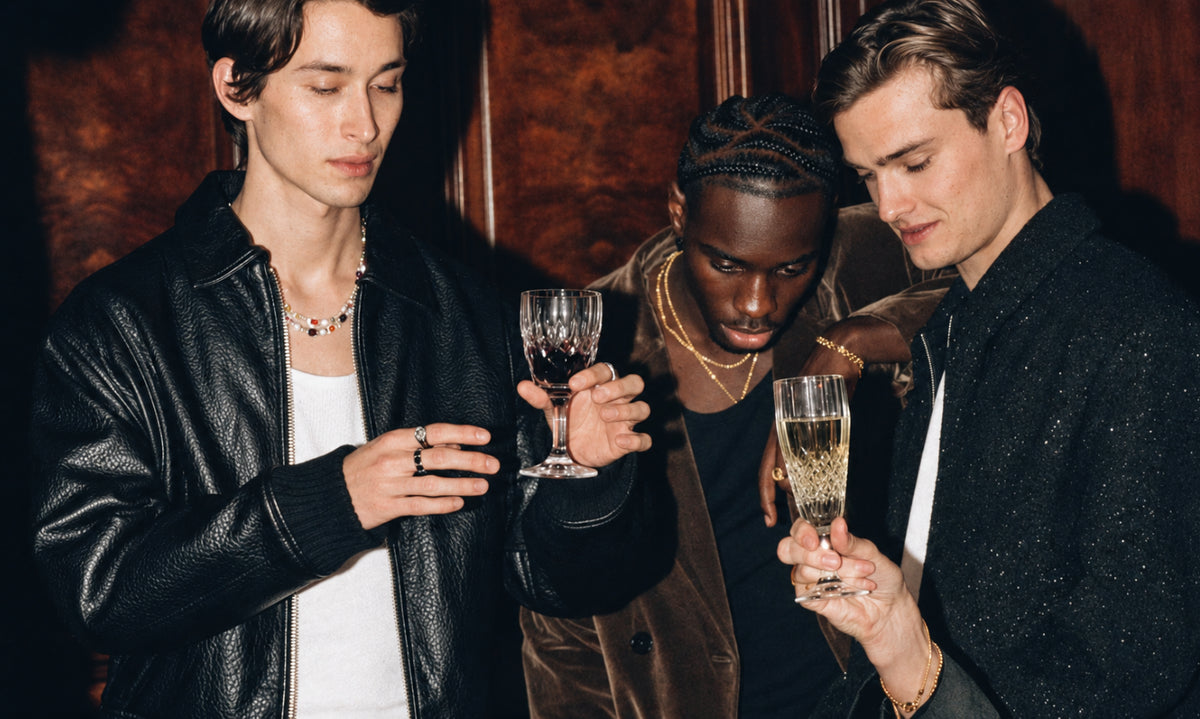
Matching Jewellery With Your Mates: Meaningful or a Bit Much?
Matching bracelets for the groomsmen. Rings to celebrate a shared achievement. There’s something nice about wearing a piece that connects you to your mates. But when does it become a bit naff?
Read more
 Ready to give.
 Hand-finished chains.
 Pendants with meaning.
 Neck and wrist, done.
 The clover collection.
 Make Your Own Set (Gold)
 Make Your Own Set (Silver)
 Make A Pendant Set (Gold)
 Make A Pendant Set (Silver)

Leave a comment
This site is protected by hCaptcha and the hCaptcha Privacy Policy and Terms of Service apply.