
Most gifted
Shop now


Cart
Your cart is empty
Your gifting options
Make your gift extra special with our luxury packaging options. Select a gift bag, gift box or a combination to create the perfect presentation.

Luxury Gift Box, Gift Bag & Wrapping Kit (€8,99)

Meaning Card (€2,50)
Add more meaning to your gift with a meaning card included with your order.
15 variations available

Gift Bag, Ribbon & Wrapping (€5,99)
The full CRAFTD gifting experience.
Includes: Premium CRAFTD gift bag, Ribbon & Wrapping Paper.

Luxury Gift Box (€5,99)
Choose your option
To My Boyfriend

To My Husband

To My Soulmate

To My Son

To My Grandson

To My Brother

To My True Friend

To My Dad

A Symbol Of Strength

A Symbol Of Faith

A Symbol Of Protection

A Symbol of Luck

A Symbol Of Safe Travel

A Symbol Of Self Belief

A Symbol Of Adventure
Article: What Is a Byzantine Chain? Meaning, Styles and Bracelets

A Byzantine chain is a woven chain made from small rings, linked in pairs and folded back on themselves to form a round, intricate pattern. It looks dense, almost like a braid of metal, and it has more texture than nearly any other chain style. We make ours as the Byzantine Bracelet, in gold and silver.
Below we look at how the weave is put together, the story behind its name, how it compares with rope, wheat and franco, and how to style one.

Rings folded into rings: the Byzantine weave in gold. Featured: Byzantine Bracelet (Gold).
Jump to:
Most chains are a single line of links, each one hooked through the next. A Byzantine works differently. Its rings travel in pairs, and every few pairs are folded back and threaded through each other, so the chain builds up in small, knotted sections rather than a flat line.
That gives it three qualities you notice straight away:
Nobody is quite sure. The name points to the Byzantine Empire, the eastern half of the Roman world that lasted for a thousand years and was famous for its goldwork. It's a fitting association for such an ornate weave, but there's no firm record showing the pattern began there.
Jewellers also call it a birdcage chain, a nod to the open, cage-like look of each folded section. Whatever you call it, the technique belongs to the same family as chainmail, where small rings are joined by hand into something far stronger and more flexible than any single ring.

Up close, every section of the weave repeats the same pattern. Featured: Byzantine Bracelet (Gold).
Traditionally, every ring is opened, threaded and closed by hand. The basic sequence runs like this:
It's slow, careful work, and the ring size sets the personality of the finished piece: small rings make a fine, delicate weave, while larger ones make a bold, chunky chain. Ours is handcrafted with interwoven links and finished at each end with engraved caps and a vintage-inspired clasp.

In silver, the shadows between the links read even sharper. Featured: Byzantine Bracelet (Silver).

The end caps are engraved to match the detail of the weave. Featured: Byzantine Bracelet (Silver).
These four are the chains people tend to confuse, because all of them look woven or twisted from a distance. Up close, the construction couldn't be more different.
| Chain | Construction | Appearance | Read more |
|---|---|---|---|
| Byzantine | Pairs of rings folded back through each other | Round, knotted, highly textured | This guide |
| Rope | Links twisted into a continuous spiral | Smooth diagonal ridges that catch the light | Rope bracelet guide |
| Wheat | Oval links braided at an angle | A stacked V pattern, like an ear of wheat | Wheat chain guide |
| Franco | Curb links shaped like a V, locked together on all four sides | Square-ish, regular and sleek | Franco chain guide |
The easy way to tell a Byzantine apart: look for the repeating "knots". Rope, wheat and franco all run in an even, continuous line, whereas a Byzantine pulses, tight section after tight section. For the wider family of necklace styles, our chain types guide covers them all.
We don't sell a Byzantine necklace, and that's a deliberate choice. The weave belongs on the wrist, for a few reasons:
If you want a woven look around the neck, our franco chain guide covers the Cali Chain, and our wheat chain guide covers the other braided option. For every bracelet style we make, browse our men's bracelet types.

Gold and silver side by side. Featured: Byzantine Bracelet (Silver).

Round in section, so it looks the same from any angle. Featured: Byzantine Bracelet (Gold).
Often the best approach. Because the weave is so busy, a single Byzantine looks finished by itself, whether that's paired with a tee or tucked under a shirt cuff.

Worn alone, it adds texture without shouting. Featured: Byzantine Bracelet (Gold).
Its round profile sits comfortably against a watch case. Pair them on one wrist, a finger's width from the watch, or move it to your other wrist so each arm carries something. Our watch and bracelets guide goes deeper on spacing and metals.

Sitting just past the wrist bone. Featured: Byzantine Bracelet (Gold).
Team it with something smoother so the texture stands out: a Cuban link bracelet for weight, or a cord or bead bracelet for contrast. Two or three pieces is usually plenty, and our guide to wearing bracelets has more on building a fuller wrist.
Gold reads warm and a touch vintage; silver looks cooler and lets the shadows in the weave stand out. Match it to your watch or rings, or browse our gold bracelets and silver bracelets to build around it.

Silver against black, with nothing else competing. Featured: Byzantine Bracelet (Silver).
A Byzantine should have a bit of movement without sliding over the hand. As a guide, one finger should fit between bracelet and wrist. If you're unsure which size to choose, measure your wrist first: it only takes a minute and a flexible tape.

The clasp closes with one hand once you've done it a couple of times. Featured: Byzantine Bracelet (Gold).

Off the wrist and laid flat after a day's wear. Featured: Byzantine Bracelet (Silver).
A chain made from small rings linked in pairs and folded back on each other. The result is a round, densely woven chain with a repeating pattern and a lot of texture.
Nobody knows for certain. The name points to the Byzantine Empire, but there's no solid record tying the weave to it. Some also call it a birdcage chain.
Yes, for everyday wear. Each section is made of several rings sharing the load, so the weave holds up well to daily use. It can still snag now and then, as every chain can.
Rope links twist into one smooth, continuous spiral. A Byzantine folds its rings into a woven, knotted pattern that looks more three-dimensional and more intricate.
No. The Cali belongs to the franco family, made of V-shaped curb links. Our only Byzantine piece is the Byzantine Bracelet.
Not at the moment. We make the Byzantine as a bracelet in gold and silver, in two sizes.
Most wrists suit 19cm, which is also our best-selling size. Go for 22cm if you have a larger wrist or prefer a looser fit.
It works well. Its rounded shape sits comfortably beside a watch, whether on the same arm or balancing the other one.
Some chains are about shine from across the room. The Byzantine works the other way: the closer you get, the more there is to see. That's what makes it such a good everyday piece, and why we think the wrist is its natural home.
Choose the gold or silver version, or see the rest of our bracelets.
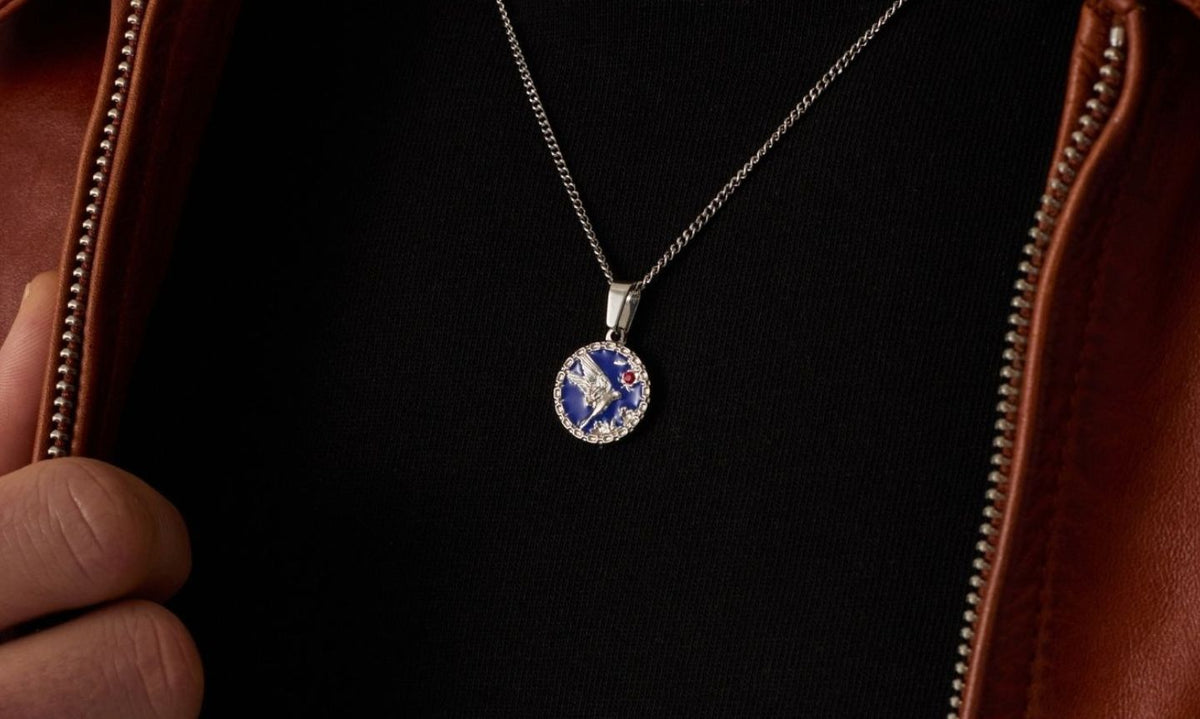
What Does a Swallow Necklace Mean?
Why did sailors wear the swallow? A bird known for finding its way home became a symbol of safe return, loyalty and hope. Here’s what that meaning looks like today.
Read more
 Ready to give.
 Hand-finished chains.
 Pendants with meaning.
 Neck and wrist, done.
 Chain and pendant. Boxed.
 The clover collection.

Leave a comment
This site is protected by hCaptcha and the hCaptcha Privacy Policy and Terms of Service apply.