

GEMSTONES



Artikel: What Is a Hamsa? The Hamsa Hand Meaning, Origins and Symbolism

What Is a Hamsa? The Hamsa Hand Meaning, Origins and Symbolism
The hamsa is one of the oldest protective symbols in the world. An open hand, usually symmetrical, often with an eye at the centre of the palm, it has been carried, hung and worn across the Middle East, North Africa and the Mediterranean for thousands of years.
Today it's one of the most popular symbols in jewellery, worn by people of every faith and none. Here's what a hamsa is, where it comes from, what it means facing up or down, why there's an eye in the palm, and how to wear one.

The hamsa: an open hand, often with an eye in the palm. Featured: the Iced Hamsa pendant in gold.
Jump to:
- What is a hamsa?
- What the hamsa hand means
- Hamsa facing up or down
- The eye in the palm
- Where the hamsa comes from
- The hamsa across faiths
- How to wear a hamsa pendant
- FAQs
What Is a Hamsa?
A hamsa is a protective amulet in the shape of an open hand. Most versions are symmetrical, with a thumb on each side, and many carry an eye in the centre of the palm.
The name means five, for the five fingers. It comes from the Arabic khamsa, and the Hebrew hamesh means the same. You'll see it spelt hamsa, khamsa or hamesh, and it goes by several other names too:
- Hand of Fatima, in Muslim tradition, after the daughter of the Prophet Muhammad.
- Hand of Miriam, in Jewish tradition, after the sister of Moses and Aaron.
- Hand of Mary, among some Christians in the Levant.
- Hand of God, a general name that belongs to no single faith.

Worn today as much for good luck as for protection. Featured: the Iced Hamsa pendant.
What the Hamsa Hand Means
At its heart, the hamsa means two things: protection and good fortune.
- Protection against the evil eye, the old belief that a jealous or envious look can bring bad luck, illness or harm. The open hand is a raised palm, a gesture that says stop.
- Good fortune, in the form of blessings, happiness, health and abundance for the person who wears it.
Those two ideas are why it's given as a gift so often, to a new baby, a newly married couple, or anyone starting something new. It's a way of wishing someone well and keeping them safe at the same time.
Hamsa Facing Up or Down
You'll see the hamsa worn both ways, and in one common reading each carries a slightly different meaning:
| Orientation | Common meaning |
|---|---|
| Fingers pointing up | A shield against evil and negative energy, often shown with the fingers spread apart |
| Fingers pointing down | An invitation for blessings, abundance and good luck, often shown with the fingers together |
It's a tradition rather than a rule, and many people choose simply the version they like the look of. Our hamsa pendant hangs with the fingers pointing down, the way the symbol is most often worn as jewellery.

Supplied on a 3mm Cuban chain. Featured: the Iced Hamsa pendant.
The Eye in the Palm
Many hamsas have an eye at the centre of the palm. It's there to watch for, and turn back, the evil eye: the hand stops it, and the eye sees it coming.
That's why the hamsa and the evil eye are so often mentioned together, but they aren't the same thing. The evil eye is the harmful look the symbols protect against, and the blue eye bead, often called a nazar, is a separate charm. A hamsa with an eye in its palm combines the two ideas in one piece.

The eye at the centre of the palm guards against the evil eye. Featured: the Iced Hamsa pendant.
Where the Hamsa Comes From
Hand-shaped protective symbols are very old. Amulets showing a protective hand were used in ancient Mesopotamia, and an engraved hand appears in a Judean tomb dating to around 800 BCE. Some historians link the symbol to the Phoenician and Carthaginian world, though that connection is debated.
Over centuries it became deeply rooted across North Africa, the Middle East and the Mediterranean, including Morocco, Algeria, Tunisia, Egypt, Turkey and medieval Spain. In Algeria it even appears on the national emblem. In the last few decades it has spread worldwide as a symbol of luck and protection.
The Hamsa Across Faiths
The hamsa predates the major religions that later embraced it, and it's never belonged to just one of them.
- In Islam, particularly in North Africa, it's known as the Hand of Fatima. In Shia tradition, the five fingers are sometimes linked to the five members of the Prophet's household.
- In Judaism, especially among Sephardi and Mizrahi communities, it's the Hand of Miriam, and it appears on everything from wedding documents to jewellery.
- Among some Christians, particularly in the Levant, it's known as the Hand of Mary.
It's often described as a symbol shared across faiths, which is part of why it has become so widely worn. If you're interested in faith pendants more broadly, our guide to the most powerful religious pendants for men covers the cross, the saints and more. For other symbols you'll see on jewellery, see symbols on jewellery and what they mean.

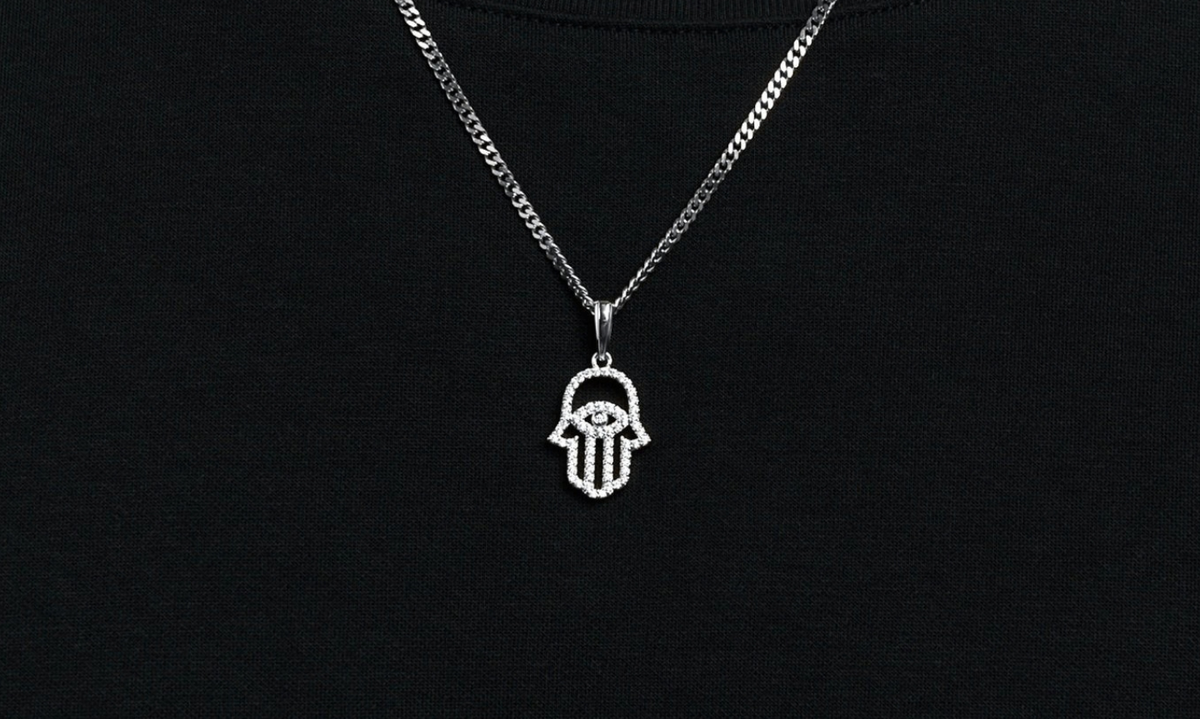
The same symbol, in silver. Featured: the Iced Hamsa pendant in silver.
How to Wear a Hamsa Pendant
A hamsa is a pendant with a meaning, so it works best given a little room.
Choose your metal
Our Iced Hamsa pendant is finished in real 18K gold and set with rows of precision-set stones, and it also comes in silver. Both come on a 3mm Cuban chain. Gold feels warmer and more traditional; silver is cooler and easier to wear with black and grey.

Rows of precision-set stones give it presence. Featured: the Iced Hamsa pendant.
Let it sit on its own
The hamsa is detailed enough to stand alone. Wear it over a plain T-shirt or with an open collar, at a length where the pendant sits on the chest rather than at the collarbone. Our chain length guide shows where each length falls.

Silver keeps it cool against black and grey. Featured: the Iced Hamsa pendant.
Layer it with meaning
If you layer, pair it with something simple, a fine chain worn shorter, or another symbol of protection such as a St Christopher or St Michael. Keep it to two pieces, so each keeps its meaning.
Look after the stones
Set stones collect dust and skin oils, which dull the sparkle. A soft brush and a drop of mild soap in warm water bring them back, and our guide on how to clean gold-plated jewellery has the full method. Store it on its own, so the stones don't scratch other pieces.

Worn on its own, a hamsa needs nothing else. Featured: the Iced Hamsa pendant.
What Is a Hamsa? FAQs
What is a hamsa?
A hamsa is a protective symbol in the shape of an open hand, usually symmetrical, often with an eye in the palm. It's worn as an amulet against the evil eye and as a charm for good luck, and it has been used across the Middle East and North Africa for thousands of years.
What does the hamsa hand mean?
Protection and good fortune. The hand is believed to ward off the evil eye, the harm caused by a jealous or envious look, and to bring blessings, happiness and health. The eye in the palm reinforces the protective meaning.
What does a hamsa facing up mean?
In one common reading, a hamsa with the fingers pointing up, often spread apart, is a shield against evil and negative energy. With the fingers pointing down, it's a symbol of blessings, abundance and good fortune. Both are widely worn, and there's no single rule.
Where does the hamsa come from?
Protective hand symbols go back to the ancient Middle East, including Mesopotamia, and appear in very early Jewish and Phoenician contexts. The hamsa as we know it today is most strongly associated with North Africa, the Middle East and the Mediterranean.
Is the hamsa a religious symbol?
It can be, but it isn't tied to one religion. It's known as the Hand of Fatima in Muslim tradition and the Hand of Miriam in Jewish tradition, and some Christians call it the Hand of Mary. Many people wear it simply as a symbol of protection and luck.
What does the word hamsa mean?
It means five. It comes from the Arabic khamsa, for the five fingers of the hand, and the Hebrew word hamesh means the same. You'll also see it spelt khamsa or hamesh.
Can anyone wear a hamsa?
Yes. The hamsa is shared across faiths and cultures, and today it's widely worn as a general symbol of protection and good luck. Wearing it with an understanding of what it means is the respectful way to do it.
Is the hamsa the same as the evil eye?
Not quite. The evil eye is the harmful look the symbols protect against, and the blue eye amulet, or nazar, is a separate charm. The hamsa often includes an eye in its palm, which is why the two are so often linked.
Where to Go From Here
The hamsa is a simple idea that has lasted thousands of years: an open hand that keeps harm away and lets good things in. Wear it as protection, as luck, or as a reminder to keep good energy close.
See the Iced Hamsa pendant, or browse all our men's pendants.
Read more
Is Silver Hypoallergenic? Sterling, Nickel and Sensitive Skin
Is sterling silver safe for sensitive skin? For most people, yes. Here's what causes a reaction, why nickel is usually to blame, which metals are kindest to sensitive skin, and what our pieces are ...
Meer informatie
Laat een reactie achter
Deze site wordt beschermd door hCaptcha en het privacybeleid en de servicevoorwaarden van hCaptcha zijn van toepassing.