

GEMSTONES




How to Clean Earrings: A Step-by-Step Guide
Earrings get dirtier than anything else you wear, and they're the thing people clean least. Ten minutes and a bottle of washing-up liquid fixes it.
Below we'll cover why they build up so quickly, the method that works at home, what changes depending on what your earrings are made of, the part almost everyone forgets, and the handful of things that do more harm than good.
Jump to:
- Why Do Earrings Get Dirty So Fast?
- How Do You Clean Earrings at Home?
- The Part Everyone Forgets: The Backs
- Does the Material Change the Method?
- What Should You Never Use on Earrings?
- How Often Should You Clean Them?
- What About the Piercing Itself?
- How Do You Keep Them Clean Between Wears?
- FAQs
Why Do Earrings Get Dirty So Fast?
Because of where they sit. An earring spends its day in direct contact with skin, behind the ear, in one of the oilier spots on the body and one of the places hair product and sweat both end up. A chain gets air on both sides. An earring post doesn't.
What builds up is a mix of sebum, dead skin, sweat and whatever you put in your hair. On a piece worn daily and never cleaned, that accumulates on the post and inside the back, out of sight, which is why an earring can look fine from the front and still need work.
None of this is a sign of poor quality, and none of it is permanent. It's the same reason a pair of glasses needs cleaning.
How Do You Clean Earrings at Home?
You don't need a dedicated jewellery cleaner. This is the whole method.
- Take the backs off and separate them from the earrings, so both get cleaned properly.
- Warm water and a few drops of washing-up liquid in a small bowl, mixed until slightly sudsy.
- Soak everything for about 10 minutes.
- Work a soft-bristled toothbrush around the post, the back of the setting and inside the back itself.
- Rinse under clean warm water until there's no soap left, holding them over a bowl rather than an open plughole.
- Dry completely with a soft, lint-free cloth, then leave them a few minutes longer before putting them in.
The last step matters more than it sounds. A damp post going straight back into a piercing traps moisture in exactly the place you don't want it. Dry them properly and you've avoided the most common reason a freshly cleaned earring irritates an ear.
The Part Everyone Forgets: The Backs
If you clean one thing on an earring, clean the back. It's pressed flat against skin all day, it has an inside surface nobody ever looks at, and on a butterfly back there's a tight join where the two loops meet that traps more than any other part of the piece.
Take them off and soak them separately. A toothbrush gets into the join; a cloth won't. And if a back has gone stiff or stopped gripping properly, that's usually build-up in the mechanism rather than wear, so a clean often brings it back.
Does the Material Change the Method?
The soap-and-water method is safe across the board. What changes is how much more you can do beyond it.
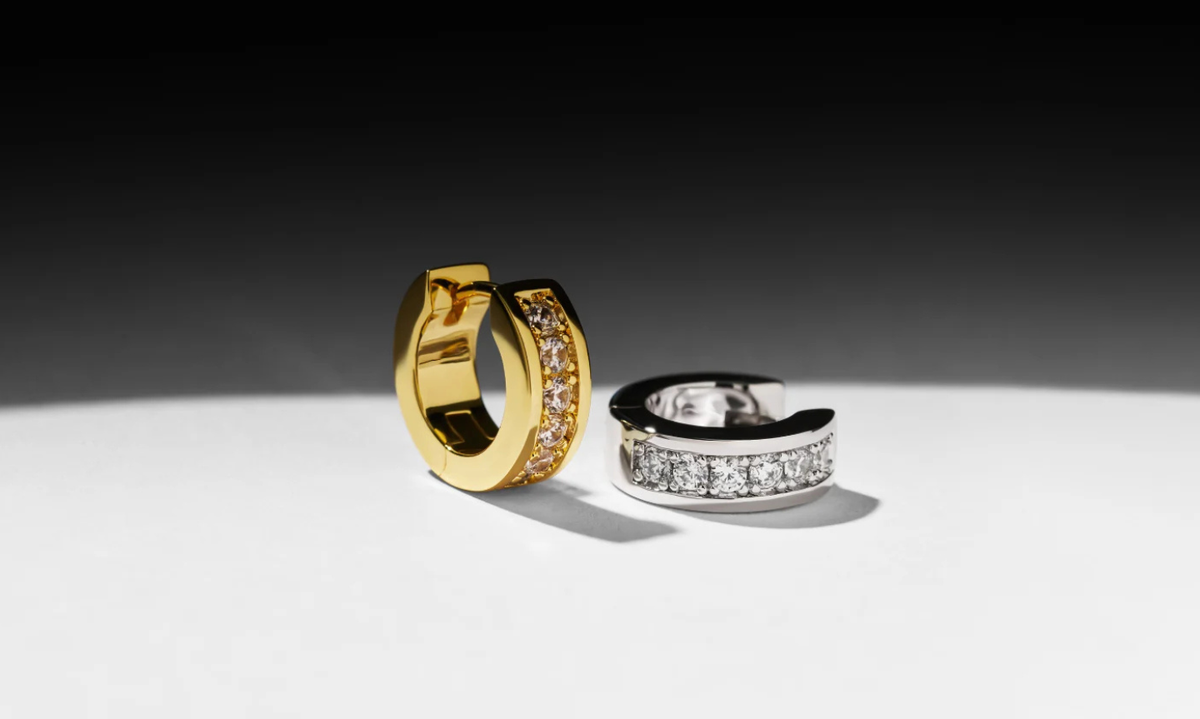
- Rhodium-finished steel is the most forgiving. CRAFTD earrings are built on 316L stainless steel finished in rhodium, chosen partly for being hypoallergenic, and they're made to handle water, heat and sweat. Steel doesn't tarnish the way a silver alloy does, so these need cleaning rather than restoring.
- 18K gold finishes want a lighter hand. Use a cloth in place of the brush wherever you can reach, and keep the contact brief. The finish is a surface layer, and every abrasive pass takes a little of it. There's more detail in our guide to how long gold plating lasts, and on the difference between 18K gold and gold vermeil.
- Sterling silver studs behave differently again, because genuine silver tarnishes. If yours have gone dark rather than dull, that's a chemical reaction rather than dirt. Our guide to cleaning sterling silver goes through every method, including one that reverses tarnish rather than scrubbing it off.
- Stones and crystal settings get the chain treatment, not the soak. Wipe them with a dry, soft cloth and keep the water away from the setting.
Not sure which you've got? A "925" mark means sterling silver, and what 925 means on jewellery covers it. Our guide to the symbols stamped on jewellery covers what the rest of the marks mean.
If It's Your Ear Reacting Rather Than the Earring Looking Dull
Worth knowing, because it's a different problem with a different answer, and the rules here are better than in most of the world.
Under EU REACH, entry 27 of Annex XVII, a post inserted into a pierced ear may not release more than 0.2 micrograms of nickel per square centimetre per week. That's the tightest limit in the whole restriction, stricter than the 0.5 that applies to jewellery in ordinary prolonged skin contact, and it exists precisely because a piercing is an open route into the body.
It caps how much nickel reaches you rather than banning nickel from the alloy, so a compliant earring can still contain some. But release is what causes the reaction, and it is limited by law here in a way it is not in the United States, which has no federal equivalent. If an earring bought from a compliant seller is irritating you, cleaning it properly is a more likely fix than the metal is.
What Should You Never Use on Earrings?
Four things, and the last one catches people out.
Toothpaste on anything plated or finished. It's a mild abrasive. On solid metal that's survivable. On a surface finish it's removing the finish.
Surgical spirit or peroxide as a routine clean. Fine for an occasional wipe of a post. As a habit, it strips oils without shifting the build-up that actually dulls an earring, and over time it can dry out or cloud some finishes.
Silver dip solutions on plated pieces. Strong enough to take the plating off along with the tarnish.
Ultrasonic cleaners on stud settings. This is the one worth knowing. Plenty of stones in stud earrings are held with adhesive rather than prongs, and an ultrasonic bath, or a long soak in hot water, can work that adhesive loose. You often don't find out until the stone falls out later. If a stone isn't visibly held by metal claws, keep it out of the ultrasonic and out of the soak.
How Often Should You Clean Them?
More often than you'd clean a chain, because of where they sit. A wipe with a soft cloth after each wear takes seconds and removes most of what causes build-up in the first place. A proper soak every two weeks or so covers a pair worn most days.
If you wear the same earrings continuously and rarely take them out, make a point of doing it, because a post that never comes out never gets cleaned. Earrings that mostly live in a box need less, but give them a wipe before they go back in.
What About the Piercing Itself?
Cleaning the earring and caring for the hole are two different jobs, and the second one has its own rules. Cleaning your earrings well makes a real difference to how the piercing behaves, but it doesn't replace looking after the piercing directly. We've covered that separately in our guide to cleaning earring holes.
One thing worth saying plainly here: if a piercing is sore, swollen, hot or weeping, that's past the point where a cleaning routine is the answer. Speak to your piercer, or a doctor if it's not settling. Nothing in this guide is a substitute for that.
How Do You Keep Them Clean Between Wears?
Put them away dry, and put them away somewhere closed. A soft pouch or a lined box keeps dust and air off them, and dry is the operative word: earrings that go into storage damp are the ones that come out looking worse than they went in.
Keeping the backs with the earrings rather than loose in the bottom of a drawer saves the other common problem, which is a clean pair of studs paired with a grubby back nobody thought to wash.
Which Earrings Are Worth Building Around?
A plain round stud is the one that goes with everything and the easiest to keep clean, with no setting to work around. A cross stud adds some detail without much more upkeep. If you want more presence, a chunky hoop reads heavier while still being a single piece of metal to clean. The full range sits in the men's earrings collection.
FAQs
What's the best way to clean earrings?
Warm water and a few drops of washing-up liquid, a 10 minute soak, then a soft toothbrush worked around the post and the back. Rinse, then dry completely before they go anywhere near your ear. That handles the large majority of everyday grime without touching anything harsh.
How do you clean earrings at home?
With what's already in your kitchen. Washing-up liquid, warm water, a soft-bristled toothbrush and a lint-free cloth are the whole kit. You don't need a jewellery cleaning solution, and for plated pieces you're better off without one.
How do you clean earring backs?
Separately, and more thoroughly than the front. The back and the post spend the day pressed against skin, so they collect more than the visible part does. Soak them apart from the earring, brush the inside of a butterfly back where the two loops meet, and rinse well.
Can you clean earrings with surgical spirit?
For an occasional wipe of the post, yes. As a routine cleaning method, no. Alcohol strips oils but does nothing for the build-up that actually dulls an earring, and repeated use can dry out or cloud some finishes over time. Soap and water does the real work.
How do you clean gold plated earrings?
Gently, and briefly. Warm soapy water, a soft cloth rather than a brush where you can, and a quick rinse. Plating is a surface layer, so anything abrasive, including toothpaste and polishing cloths meant for solid metal, wears it thinner every time you use it.
How often should you clean your earrings?
A wipe after each wear, and a proper soak every couple of weeks if you wear them most days. Earrings sit against skin for longer than almost anything else you own, so they need it more often than a chain or a ring.
Do CRAFTD earrings tarnish?
Our earrings are built on 316L stainless steel finished in rhodium, or finished in 18K gold, rather than sterling silver. Steel doesn't tarnish the way a silver alloy does, which is why these need less upkeep than a sterling stud. They still collect everyday grime, and that still wants cleaning off.
Can you shower or swim in earrings?
Ours are made to handle water, heat and sweat, so a shower won't hurt them. Swimming pools and the sea are still worth avoiding where you can, because chlorine and salt sit on the metal after you get out and neither does a finish any favours. Rinse and dry them if you've been in either.
Can you clean earrings while you're wearing them?
Not properly. You can wipe the visible front, but the post and the back are the parts that need it, and you can't reach either one while they're in. Take them out, clean them, dry them fully, put them back.
Where to Go From Here
Take the backs off, ten minutes in soapy water, dry them properly. That's the job, and doing it every couple of weeks is the difference between earrings that look new and earrings that look worn.
Have a look through the earrings collection if you're adding to yours, or how to clean metal jewellery if it's not just earrings you're working through.
Read more
Style Guides
White Gold vs Rose Gold: Which Should You Wear?
Both are the same gold at the same karat. The difference is what they're mixed with, and where the colour actually lives: rose gold's runs through the metal and white gold's sits on top of it as a ...
Read more
Style Guides
The 10 Most Expensive Chains in the World (And What They're Really Worth)
Rick Ross's self-portrait chain tops nearly every list at a reported $1.5 million, and nobody can tell you where that number came from. Lil Jon's is the only one on the list Guinness ever actually ...
Read more
Leave a comment
This site is protected by hCaptcha and the hCaptcha Privacy Policy and Terms of Service apply.