

Edelsteine

Bangles for Men: Open, Closed and How to Choose
Bangle is one of those jewellery words that gets used loosely. Strictly, it means a rigid circle of metal without a clasp or an opening, slipped on over the hand. In practice, most shops use it for any solid bracelet, including the open bands most men actually wear.
Below, we sort out the difference, trace where the bangle came from, explain how sizing changes between closed and open designs, and show where our own open bangles fit in.

One solid line of gold, no clasp in sight. Featured: Classic Cuff 5mm (Gold).
Jump to:
- What makes a bracelet a bangle?
- Where the bangle comes from
- Closed or open
- Sizing a bangle: hand vs wrist
- Our open bangles, width by width
- Building a bangle stack
- FAQs
What Makes a Bracelet a Bangle?
Three things set a bangle apart. It's rigid, so it holds its round shape even off the wrist. There's no clasp, chain or link anywhere on it. And it's worn with a bit of freedom to move, rather than fastened tight.
The argument is over the gap. To a purist, a bangle is a full, unbroken circle. Plenty of jewellers also sell open versions as bangles, sometimes labelled open bangles or cuff bangles, and that open shape is what most men go for. Our piece on what a cuff bracelet is looks at the open band in detail; this piece looks at the bangle family as a whole. To see where bangles sit next to chains, beads and tennis styles, read our rundown of men's bracelet types.
Where the Bangle Comes From
English borrowed the word from the Hindi bangri, a term for a glass bracelet, during the period of British trade in India. The object is far older than the word. Bangles have turned up at sites of the Indus Valley civilisation, and a small bronze figure found at Mohenjo-daro, thought to be more than 4,000 years old, is shown with her arm stacked with them.
Across South Asia, bangles have long carried meaning as well as decoration, and men have their own place in that story. In Sikh tradition, the kara, a plain steel or iron bangle, is one of the five articles of faith and is worn by men and women alike.
The bangle has lasted for a simple reason: it's one piece of solid metal, with nothing to fasten and very little that can go wrong.
Closed or Open: Which Suits a Man's Wrist?
Both count as bangles in everyday speech. They just behave very differently once they're on.
The closed bangle
A closed bangle has to clear your knuckles to go on, so it's always a fair bit bigger than your wrist. That means it moves. It rides up the forearm when you raise your arm, drops back towards the hand when you lower it, and taps against a desk or a watch. Some men like that loose, easy feel. Others find it gets in the way, especially with broad hands and slimmer wrists, where the hand-to-wrist gap is widest.
The open bangle
An open bangle is cut through at the back, so it goes on at the side of the wrist instead of over the knuckles. Because it never has to clear the hand, it can sit much closer to the wrist and stay roughly where you leave it. A little flex in the metal lets you fine-tune the fit.

The gap that makes it an open bangle. Featured: Classic Cuff 3mm (Silver).
That's why every bangle we make is open. It suits more wrists, sits neater under a shirt sleeve and comes off in a moment when you need it to.

Rounded ends, so the opening sits smoothly against the skin. Featured: Classic Cuff 5mm (Gold).
Sizing a Bangle: Hand vs Wrist
The number you need depends entirely on the shape.
For a closed bangle, measure your hand
- Fold your thumb in. Bring it across your palm towards your little finger, the way your hand narrows when a bangle goes on.
- Measure the knuckles. Wrap a soft tape around your hand at the knuckles, its broadest point. A length of string marked with a pen and laid against a ruler works too.
- Size up slightly. That figure is the smallest inside circumference that will pass over your hand, so go a touch above it to stop the bangle catching on the way on and off.
For an open bangle, measure your wrist
Measure the narrowest point of your wrist, where a watch strap would sit, then allow about 1cm of room. Our two sizes are 19cm and 22cm, and 19cm fits most wrists; the flex in the band covers the space in between. For the full method, use our bracelet measuring guide.

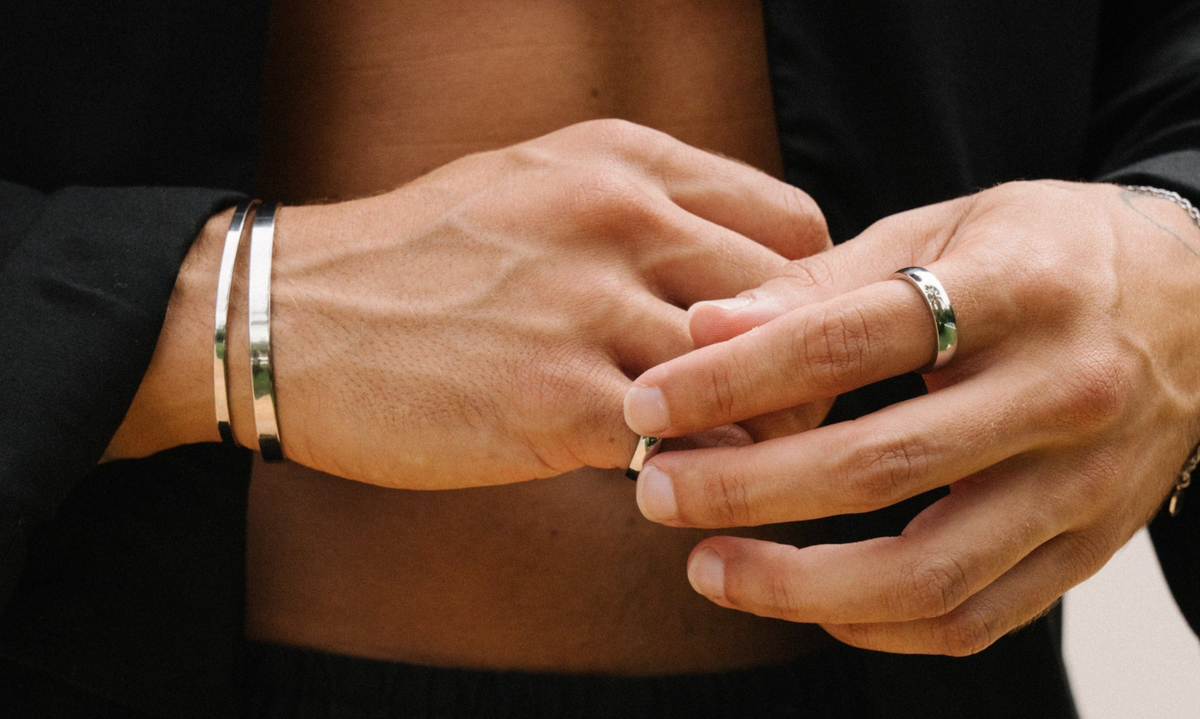
Snug at the wrist, never tight. Featured: Classic Cuff 5mm (Silver).
Our Open Bangles, Width by Width
Every bangle we make shares one build. Underneath, it's 316L stainless steel all the way through; on the outside, real 18K gold, 18K rose gold or rhodium, sealed against tarnish. What changes from one to the next is width and surface.
3mm: the quiet one
The Classic Cuff 3mm is the slimmest bangle we make, a fine band that finishes a bare wrist and slides under a shirt sleeve without catching. There's silver and gold, plus rose gold.

Our slimmest width, here in rose gold. Featured: Classic Cuff 3mm (Rose Gold).
5mm: the one that leads
At 5mm, the Classic Cuff shows more metal and holds a wrist by itself. It's the width to pick if your bangle is going to be the main piece you wear; we make it in gold, rose gold and silver.

Built to carry a wrist alone. Featured: Classic Cuff 5mm (Gold).
Rope: texture on the same shape
The Rope Cuff twists the band into a sculpted rope, so light catches it from every angle, and it's finished with our signature clovers. Choose between gold and silver.

A twisted surface that picks up the light. Featured: Rope Cuff (Gold).

The same twist in silver. Featured: Rope Cuff (Silver).
Rectangle: a flat top plate
Only available on our EU store. The Rectangle Bangle 5mm keeps the open back but sets a flat, rectangular plate across the top, which gives the band a sharper, more architectural outline. There's a gold and a silver version, in limited numbers.

A flat plate across the top of an open band. Featured: Rectangle Bangle 5mm (Gold).
Matching the metal
The easiest way to choose a finish is to look at what's on you already. Match the bangle to your watch case or everyday chain, and the two will look as if they came together. If you're torn, our silver versus gold breakdown lays out both sides.
Building a Bangle Stack
Bangles have been worn in numbers for as long as they've existed, and two open bangles together is about the simplest stack there is. Some simple habits help it look deliberate:
- Vary the width. A 3mm beside a 5mm gives the eye a lead piece and a supporting one. Two matching widths can read as a doubling-up rather than a choice.
- Hold one metal. Two golds or two silvers read as a pair. If you do mix, let one metal clearly dominate.
- Add something softer. Links or a beaded bracelet beside a rigid band break up all that solid metal.
- Give the watch space. Wear the stack on your other wrist, or keep a single slim bangle beside the watch so nothing knocks against the case.
- Stop at three. Beyond that, a stack starts to clink and catch on sleeves.

Two widths, one metal. Featured: Classic Cuff 5mm (Silver).

Rose gold, doubled up. Featured: Classic Cuff 3mm (Rose Gold).
Our styling rules for every kind of bracelet take it further.
Bangle FAQs
Is a bangle the same as a cuff?
Not strictly. A traditional bangle is a closed circle that passes over the hand, while a cuff has an opening at the back. Many jewellers now call open designs bangles as well, hence the overlap between the two words.
Do men wear bangles?
Yes, and they have for centuries. Open designs are the easiest way in, because they're sized by wrist, not by hand, and sit closer once they're on.
How should a bangle fit?
A closed bangle sits loose and travels along the forearm, because it has to clear your hand. An open bangle should hug the wrist without pinching and still turn a little.
What size bangle do I need?
For a closed bangle, tuck your thumb into your palm and measure around your hand at the knuckles. For our open bangles, take your wrist measurement and add about 1cm. 19cm fits most wrists, and 22cm gives more room.
Which wrist should a bangle go on?
Either works. Keeping it on the free wrist, away from your watch, stops the metal knocking against the case.
Can you wear two bangles at once?
Yes. Pair a 3mm with a 5mm, both gold or both silver, and the stack looks planned rather than accidental.
Can I shower with my bangle on?
Ours are 316L stainless steel under an 18K gold, rose gold or rhodium finish, which means rain and the shower won't trouble them. Leave yours on the side before a swim, a hot tub or a dip in the sea.
Are your bangles suitable for sensitive skin?
The core is 316L steel, and 316L releases very little nickel. That's why it's a common choice for people who react to cheaper metals.
Your First Bangle
Start with one open bangle in whatever metal you reach for most: 3mm for something low-key, 5mm for something people notice. If you find yourself reaching for it every morning, a second width makes an easy next step.
Every style sits together in our cuff bracelets collection.
Read more
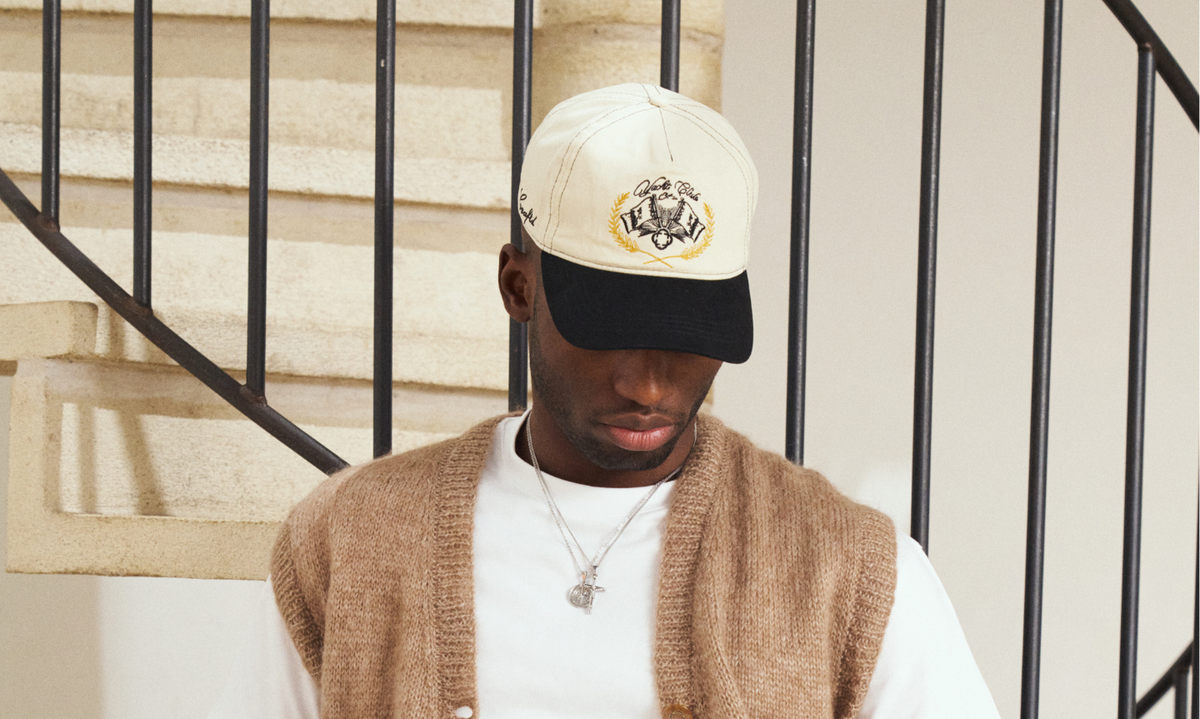
Types of Caps for Men: Panels, Fabrics and Fit
Five panels or six, structured or soft, twill, cord or wool? Here’s how caps are built, how the main types differ, how a cap should fit, and where each of our styles fits in.
Weiterlesen
Black Rings for Men: Meaning and What They’re Made Of
Stone, enamel, tungsten or oxidised silver? Here’s what a black ring can say, the four ways a ring gets its colour, how each one wears over time, and which of ours suits you.
Weiterlesen
Hinterlasse einen Kommentar
Diese Website ist durch hCaptcha geschützt und es gelten die allgemeinen Geschäftsbedingungen und Datenschutzbestimmungen von hCaptcha.