
GIFT SETS
SHOP NOW

Popular searches

Warenkorb
Dein Warenkorb ist leer
Your gifting options
Make your gift extra special with our luxury packaging options. Select a gift bag, gift box or a combination to create the perfect presentation.

Luxuriöse Geschenkbox, Geschenktüte & Verpackungsset (€8,99)

Bedeutungskarte (€2,50)
Verleihen Sie Ihrem Geschenk mehr Bedeutung mit einer Bedeutungskarte, die Ihrer Bestellung beiliegt.
15 variations available

Geschenktüte, Schleife & Geschenkpapier (€5,99)
Das volle CRAFTD-Geschenkerlebnis.
Inklusive: Hochwertige CRAFTD-Geschenktüte, Schleife und Geschenkpapier.

Luxus-Geschenkbox (€5,99)
Choose your option
An meinen Freund

An meinen Ehemann

An meinen Seelenverwandten

An meinen Sohn

An meinen Enkel

An meinen Bruder

An meinen wahren Freund

An meinen Vater

Ein Symbol der Stärke

Ein Symbol des Glaubens

Ein Symbol des Schutzes

Ein Symbol des Glücks

Ein Symbol für sicheres Reisen

Ein Symbol des Selbstvertrauens

Ein Symbol des Abenteuers
A Belcher chain is a men's necklace built from small, round, open links of uniform size, worn close to the neck as a soft continuous line of circles. It's one of the older chain styles in British jewellery, named after the early-1800s English boxer Jem Belcher, and one of the shapes most often confused with a modern Connell chain.
Below, we'll cover what actually defines a Belcher, where the name traces to, how it wears, how it differs from the Connell (they aren't the same chain, despite what a lot of retailers imply), and where to look inside our range if you're after the same slim, understated feel.
Jump to:
A Belcher chain is defined by its links. Small, round, and open, sized identically all the way along the chain. Each link is a plain circle, and the chain sits on the neck as a soft continuous line of those circles rather than as a defined edge of flat surfaces. That circular geometry is the whole design.
The Belcher is one of the older chain shapes in British jewellery, sometimes called an "open link" chain in trade terms. It reads gentler than a curb chain and rounder than a cable chain, sitting in a category of its own inside the everyday-chain family.
For the wider context on how the Belcher sits alongside the eight other main chain styles, see our Types of Men's Chains guide.
Belcher chains are made from drawn wire, cut into small equal segments, formed into individual circular links, and soldered closed one at a time. Every link is a self-contained loop, and the finished chain is the result of hundreds of those identical loops threaded through each other.
A few practical notes worth knowing:
Solid vs hollow. A solid Belcher chain is made from wire that goes all the way through the diameter of the link. A hollow Belcher uses tubed wire, which is lighter, cheaper, and easier to crush or dent. Solid always feels heavier in the palm at the same width, and it's what you want if you plan on wearing the chain every day for years.
Link diameter is what defines the look. A Belcher at 1mm reads as a delicate everyday piece. At 3mm the same shape starts to read as a statement chain. The Belcher's geometry doesn't change with width the way a Cuban's does; only the visual weight shifts.
Polished vs matte finish. Because Belcher links are round, a polished finish makes the chain catch light in scattered points rather than along a single edge. Matte or brushed Belchers are rarer but sit softer against the skin visually.
The Belcher chain takes its name from Jem Belcher, an English bare-knuckle boxing champion born in Bristol in 1781. Belcher held the title of Champion of England from 1800, and he became one of the earliest celebrities in the modern sense: a working-class fighter whose face, style, and clothing choices spread through the public via prints and newspaper illustrations.
The chain style attached to his name because he wore one openly in an era when men's neckwear was almost entirely hidden under high collars and cravats. The specific chain he wore, a plain round-link piece worn short to the neck, became visual shorthand for him. Over the following decades British jewelers adopted the term "Belcher chain" to describe the shape.
Two centuries on, the name has stuck in the UK and across the Commonwealth. In American and global trade language, the same shape often gets called an "open link" or simply a round-link chain. Same piece, different linguistic history.
They're different chain shapes. The confusion between the two is one of the most common we hear, and it's worth clearing up in plain terms.
A Belcher chain has round, open links, uniform in size. The chain reads as a soft curve of circles across the neck.
A Connell chain has flat, twisted links that lie flush against the skin. It's a curb chain, in the same family as the Cuban. The chain reads as a clean straight edge across the neck rather than a curve.
Some retailers use the two terms interchangeably, which doesn't help. It probably comes from the fact that both are slim, both suit everyday wear, and both became newly popular after Normal People aired in 2020. But the link geometry is completely different, and once you've seen the two side by side, they don't look the same at all.
If you came here searching for the chain that Paul Mescal wore in the show, that's the Connell. For the full read, see our Connell chain guide. If you came looking for the traditional round-link Belcher shape, keep reading.
The Belcher is a solo-first chain. Its round-link geometry is soft enough that it doesn't demand attention, but distinctive enough that layering it with another chain tends to muddle both. Wear it on its own and let the shape do the work.
With a plain tee, the Belcher reads clean and understated. Under a shirt collar it disappears without pulling. With a fine knit at the neckline it sits softly and doesn't compete with the fabric texture. That's the range: it works with quiet outfits and rewards restraint elsewhere.
Pendants pair reasonably well with a Belcher because the round links let a pendant sit without twisting. Small to medium pendants read best; a heavier pendant will bunch the round links at the low point rather than pulling them into a clean V, which is what happens on a curb.
If you want to layer, the Belcher can sit above a heavier curb like a Cuban, but rarely below one. The round links tend to catch on a chain with sharper edges when they sit on top of each other.
The Belcher sits in a different family to most of the everyday chains men look at. Short answers on each comparison:
Belcher vs Cuban. Different families. The Cuban has flat, sculpted, heavier links that lead an outfit; the Belcher has round, open, plain links that recede into it. If you want the chain to be noticed, Cuban. If you want it to be part of the outfit, Belcher.
Belcher vs Curb. Also different families. A curb chain (like our Connell) has flat twisted links that lie flush and define a straight edge. A Belcher has round open links that curve. Same everyday intent, completely different aesthetic.
Belcher vs Rope. Different families again. The rope is a twisted, woven chain that catches light along its length and reads with movement. The Belcher is round and static by comparison, catching light in scattered points rather than a continuous run.
The through-line: the Belcher is the outlier of the everyday-chain shapes. Cuban, curb, figaro, and rope all sit in the "flat or twisted link" families. The Belcher is the round-link exception.
Honest note upfront: traditional Belcher chains sit outside the core of our current range. Our focus in the slim-everyday-chain category has moved toward the Connell curb, which is the piece most men now buy when they come to us looking for a slim chain they can wear every day. Stock on any dedicated Belcher SKU is worth checking directly before ordering.
If you came here specifically for a traditional round-link Belcher and want it as a collector piece, a UK jeweler working in Belcher chains directly is the more reliable route. That's a piece of trade-language honesty we'd rather give you than sell you a substitute.
If you came here because you wanted a slim, understated everyday chain and the Belcher name was the closest match you knew, the piece you actually want is probably the Connell in silver at 22 inches. It's a curb chain rather than a round-link, so the aesthetic isn't identical, but the everyday feel, the weight, and the way it wears under a shirt collar are all in the same category. Ninety percent of men who arrive on our site searching for a Belcher end up with the Connell in hand, and none of them come back saying it was the wrong call.
The Belcher is easier to care for than most chains because there's very little geometry for residue to catch on. Round links have no flat faces for skin oil to build up on, and no tight joints for cologne or sweat to settle into. A soft cloth and occasional wash is all a well-made Belcher needs.
Daily. Wipe the chain with a soft cloth before you put it away. Ten seconds now saves you a longer clean later on.
Every few weeks. Warm water, a drop of mild soap, five minutes of soaking, then rinse and pat dry. Avoid ultrasonic cleaners and harsh chemicals unless the piece is certified for them.
In water. Belcher chains handle showers and pools fine. The one thing that shortens their life is salt water sitting on the metal, so a freshwater rinse after the sea keeps the finish sharp for longer.
Storage. Lay the chain flat in a shallow tray or a soft pouch. Round links don't kink the way flat links do, but they'll tangle if you leave them in a knotted heap for months.
Silver. Sterling silver Belchers tarnish naturally when they aren't worn. The best prevention is regular wear. A specialist silver cloth resets the finish inside a minute if the piece does dull.
A Belcher chain is a men's necklace built from small, round, open links of uniform size. It's named after the early-1800s English boxing champion Jem Belcher, and it sits in the everyday-chain family alongside the Cuban, curb, and figaro.
No. The Belcher has round, open links; the Connell is a curb chain with flat, twisted links. Same everyday intent, different link geometry. Some retailers use the terms interchangeably, but the two chains don't actually look the same in the hand.
The name traces back to Jem Belcher, an English bare-knuckle boxing champion born in Bristol in 1781. He wore a plain round-link chain in an era when men's neckwear was usually hidden, and the style became attached to his name. British jewelers adopted the term in the decades after.
Both wear them. Slim widths at longer lengths read as men's; slimmer widths at shorter lengths read as women's. The chain shape itself is neutral.
For everyday wear, 1mm to 2mm reads slim and understated. 3mm starts to read as statement. Above 3mm the Belcher shape moves out of the everyday category and into occasion wear.
The bulk of men who buy a Belcher choose somewhere in the 50 to 55cm range. Shorter lengths keep the chain sitting close to the throat, which is where the style historically sat; longer drops the chain onto the chest and reads more contemporary.
Yes, with small to medium pendants. The round links let a pendant hang without twisting. Heavier pendants pull the round links into a bunched V rather than a clean line, which reads worse than the same pendant on a flatter chain.
Yes. The Belcher has been in continuous rotation in British menswear for around two centuries, and the slim everyday-chain moment kicked off by Normal People in 2020 renewed interest in the round-link shape alongside curb chains. If you want a chain that doesn't chase trends, this is a defensible choice.
The clasp is the giveaway. Look for a hallmark stamp: 10K, 14K, 18K, or 24K if the piece is solid gold, or GP, GEP, or HGE if it's plated. Gold-filled sits between the two and marks up as GF. The other quick check is weight in the palm. A plated piece always feels lighter than a solid piece at the same width.
Our range currently centers on the Connell curb chain rather than a dedicated Belcher SKU. Stock on any Belcher-labeled piece is worth checking directly before ordering. For anyone who came in looking for a slim everyday chain and doesn't specifically need the round-link geometry, the Connell is the piece we'd point you to.
If you came here looking for a slim everyday chain, the Connell in silver is the piece we'd start with. Different link geometry to a Belcher, same everyday intent, and the chain we sell more of than anything in the range.
For the wider view of how the Belcher sits alongside the other main chain shapes, our Types of Men's Chains guide walks through each one. And the full chain collection is here if you'd rather browse the range.
This guide was put together by the CRAFTD team, from years of fitting, sizing, and shipping men's chains to men who wear them every day.
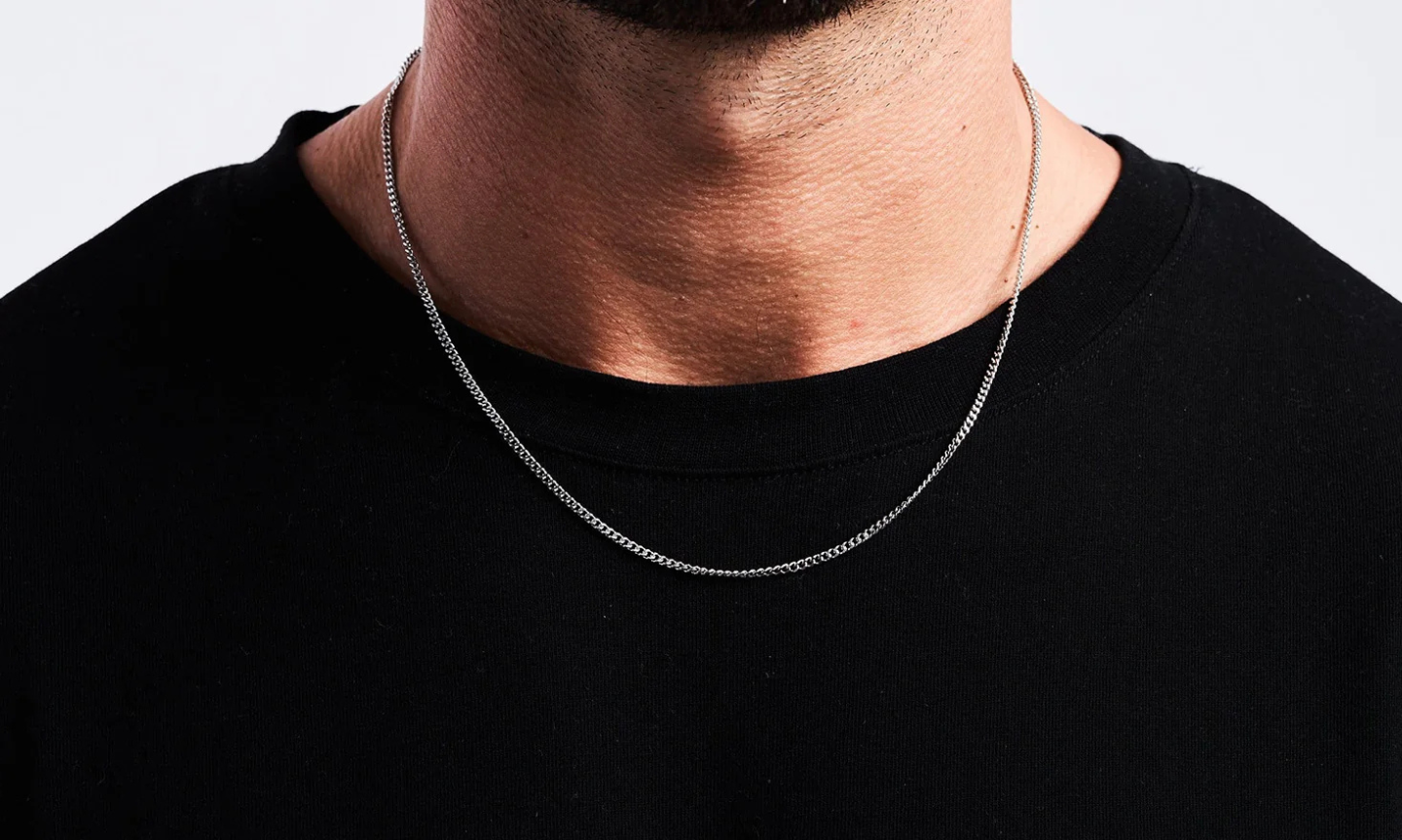
What is a Connell Chain? The Story Behind our Bestseller
Small, silver, and worn by Paul Mescal in Normal People. The Connell chain became the piece every man suddenly wanted. Here's what it is, how to wear it, and why it's our bestseller.
WeiterlesenWhat Is a Figaro Chain? The Story Behind an Italian Classic
The Figaro is one of Italy’s most recognisable chain styles, defined by its signature three-short, one-long link pattern. Here’s where it came from, what sets it apart and how to wear it.
Weiterlesen

Hinterlasse einen Kommentar
Diese Website ist durch hCaptcha geschützt und es gelten die allgemeinen Geschäftsbedingungen und Datenschutzbestimmungen von hCaptcha.