
GIFT SETS
SHOP NOW

Popular searches

Cart
Your cart is empty
Your gifting options
Make your gift extra special with our luxury packaging options. Select a gift bag, gift box or a combination to create the perfect presentation.

Luxury Gift Box, Gift Bag & Wrapping Kit (€9,44)

Meaning Card (€2,63)
Add more meaning to your gift with a meaning card included with your order.
15 variations available

Gift Bag, Ribbon & Wrapping (€6,29)
The full CRAFTD gifting experience.
Includes: Premium CRAFTD gift bag, Ribbon & Wrapping Paper.
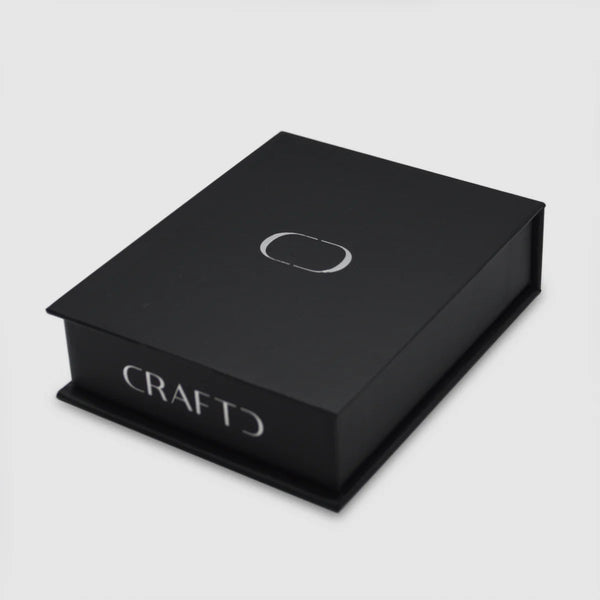
Luxury Gift Box (€6,29)
Choose your option
To My Boyfriend

To My Husband

To My Soulmate

To My Grandson

To My Brother

To My True Friend

To My Dad

A Symbol Of Strength

A Symbol of Luck

A Symbol Of Safe Travel

A Symbol Of Self Belief

A Symbol Of Adventure
Most advice on this treats it like a personality test. Work out your undertone, get sorted into a category, and wear that metal for the rest of your life.
That's not how anyone actually wears jewellery.
The honest answer is that both suit you, that the question worth asking isn't which metal but which piece, and that wearing the two together is now one of the most deliberate things you can do rather than a mistake to avoid. Below we'll go through the real differences, what skin tone genuinely decides, and how to build a collection that works in both.
Jump to:
Silver reads cooler, sharper and more understated. Gold reads warmer, richer and more deliberate. Both work on almost everyone.
If you want the two-second version: pick the metal that matches the pieces you already wear most — your watch, your ring, your glasses. Coherence is what makes jewellery look considered, and coherence is a decision about your whole look rather than about your skin.
And if you're stuck between them, that's usually a sign the answer is both. More on that below, because it's the part most guides skip and it's the one that actually changes how you wear jewellery.
Here's the reframe that makes this whole decision easier.
Nobody falls in love with a metal. They fall in love with a piece. A Cuban chain at the right width. A signet ring that sits properly on the hand. A pendant that means something. The metal is a finish on that decision, not the decision itself.
So flip the order. Find the piece first, then look at it in both.
Most of what we make comes in silver and gold, which means you can put the same chain, at the same width, on the same neck, and just look at it two ways. That takes about thirty seconds and it settles the question far better than any undertone chart, because you're not judging a colour in the abstract — you're judging the actual thing you'd wear, against your actual skin, in your actual mirror.
Nine times out of ten one of them will just look more like you. That's your answer, and it's a better answer than a rule, because it accounts for everything a rule can't: your hair, your wardrobe, your build, how you carry yourself.
And if both look right, you've learned something more useful than a preference. You've learned you can wear either — which means every piece in the range is available to you rather than half of it.
Worth covering properly, because it's the advice everyone leads with and it's more useful as a nudge than a rule.
The conventional version: cool undertones suit silver, warm undertones suit gold. Check the veins on your inner wrist — bluish suggests cool, greenish suggests warm — or notice whether you look better in pure white or in cream.
The effect is real. A warm metal against warm skin does harmonise, and a cool metal against cool skin does look crisper. If you've ever put on a chain and thought it looked slightly off without knowing why, undertone may well have been part of it.
But it's a weak effect, stated far too strongly. Most men have neutral undertones and genuinely suit both. Skin also changes — a tan shifts you warmer for a few months a year. And plenty of people look best in the metal that theory says shouldn't work on them, because contrast can be as flattering as harmony. A cool, bright metal against warm skin pops rather than clashes.
So use it as a tiebreak, not a verdict. If you've tried a piece in both and honestly can't choose, undertone is a reasonable way to break the deadlock. If you've tried both and one clearly looks better, trust your eyes over the vein test. Your eyes are looking at the actual piece; the theory isn't.
If you're genuinely unsure, this is the quick version:
| Check | Cool undertone | Warm undertone |
|---|---|---|
| Veins on your inner wrist | Look blue or purple | Look green or olive |
| Which white suits you better | Pure, bright white | Cream, ivory, off-white |
| Your skin in strong sun | Burns first, goes pink | Tans easily, goes golden |
| Hold silver foil, then gold, under your chin | Silver looks crisper | Gold looks richer |
| So the theory says | Silver, steel, white metals | Gold, vermeil, warm metals |
And if your answers are split, that's the most common result there is. A neutral undertone means both genuinely work, you're in the majority, and you can stop looking for permission.
This is the part that gets left out of every guide on this topic, and it matters more than colour does.
In men's jewellery, "gold or silver" is often not a choice between two solid precious metals. It's usually a choice between constructions, and the construction decides how the piece ages.
Silver-coloured pieces are typically one of two things. Genuine sterling silver — 92.5% silver, a real precious metal, colour all the way through, and it tarnishes and polishes back. Or stainless steel, usually finished in rhodium for brightness, which isn't precious but doesn't tarnish, corrode or fade.
And there's a distinction worth making here that almost nobody draws. A rhodium finish over steel and a gold finish over brass are both coatings, but they are not the same proposition, because of what's waiting underneath. Steel is already silver-coloured and already inert. If a rhodium finish ever dulls, what shows through is more silver-coloured, non-reactive metal. On a gold-plated brass piece, what shows through is a different colour and a metal that reacts with skin. The coating isn't the risk. What's under the coating is.
Gold-coloured pieces are usually one of three. Solid gold, which is rare at everyday prices. Gold vermeil, a thick layer of real gold over solid sterling silver, to a legal 2.5 micron minimum. Or gold plated, real gold bonded over a base metal — and this is where quality varies enormously, because what's underneath decides everything. Gold over a stainless steel core lasts for years; thin gold over brass gives you a season.
So the real question hiding inside "silver or gold" is often: solid, or coated? A sterling chain and a plated gold chain aren't two colours of the same product. One will look the same in five years and the other depends entirely on how it was built.
Which is a good thing to know before you spend, and it's why what gold plated means is worth ten minutes if you're buying gold, and what 925 means is worth the same if you're buying silver. If the gold you're weighing up is white gold, that's a different comparison again — white gold vs silver covers it.
Neither is high-maintenance. They just ask for different things.
Sterling silver tarnishes. It's a reaction with sulphur compounds in the air, it's a sign the silver is genuine, and it comes off with a polishing cloth in a couple of minutes. Store it dry and closed and it happens far more slowly. Free, quick, and it works every time.
Stainless steel asks for essentially nothing. No tarnish, no corrosion, no fade. It's the lowest-maintenance option in either colour, and it's why so much men's everyday jewellery is built on it.
Gold plating wears. Not quickly if it's well made over a stable core, but it is a surface layer and surface layers thin at the points that take the most contact — clasps, edges, the underside of a ring. Keeping it out of chlorine and salt water, and off before harsh cleaning products, is most of the job.
Gold vermeil sits in between. More gold on top than plating, over a precious base, and it wants a gentler hand than steel does.
The practical upshot: silver asks for two minutes now and then, gold asks you to be slightly careful. How to clean gold jewellery and how long sterling silver lasts cover each side properly.
| Silver | Gold | |
|---|---|---|
| The look | Cooler, sharper, more understated | Warmer, richer, more deliberate |
| Usually made from | Sterling silver, or steel finished in rhodium | Solid gold, vermeil, or gold over a core |
| What's underneath | Silver-coloured metal either way | A different colour, and sometimes a reactive one |
| What goes wrong | Tarnish on sterling, very little on steel | The gold layer thinning at high points |
| Upkeep | A polishing cloth, occasionally | Keep it out of chlorine, off before cleaning |
| Cost | Lower | Higher for the same piece |
| Reads as | Quiet confidence | Presence |
| Best with | Cool colours, black, grey, denim, tailoring | Earth tones, white, olive, brown, streetwear |
The rule against mixing metals was never a rule. It was a habit, and it's over.
Mixed metals now read as one of the clearest signals that someone dresses on purpose rather than by default. The reason is simple: matching is easy, and mixing takes a decision. People can tell the difference.
But there's a real distinction between mixing and just wearing two metals at once. The first looks intentional. The second looks like you lost the matching piece. Four things separate them:
1. Repeat each metal at least twice. This is the single most useful rule in the whole article. One gold piece among four silver ones reads like an accident. Two gold pieces among four reads like a choice. Repetition is what tells the eye you meant it.
2. Pick a dominant metal. Aim for something like seventy-thirty rather than fifty-fifty. One metal carries the look, the other punctuates it. An even split has no centre and tends to look uncertain.
3. Mind your watch. Whatever metal your watch case and bracelet are, that's your anchor whether you chose it or not — it's the largest and most consistent piece of metal on you. Build around it rather than ignoring it.
4. Mix across zones, or layer within one. Both work. Silver at the wrist and gold at the neck reads relaxed and effortless. A stacked wrist with both, or layered chains in both, reads bolder and more considered. What sits awkwardly is a single stray piece in the wrong metal with nothing to answer it.
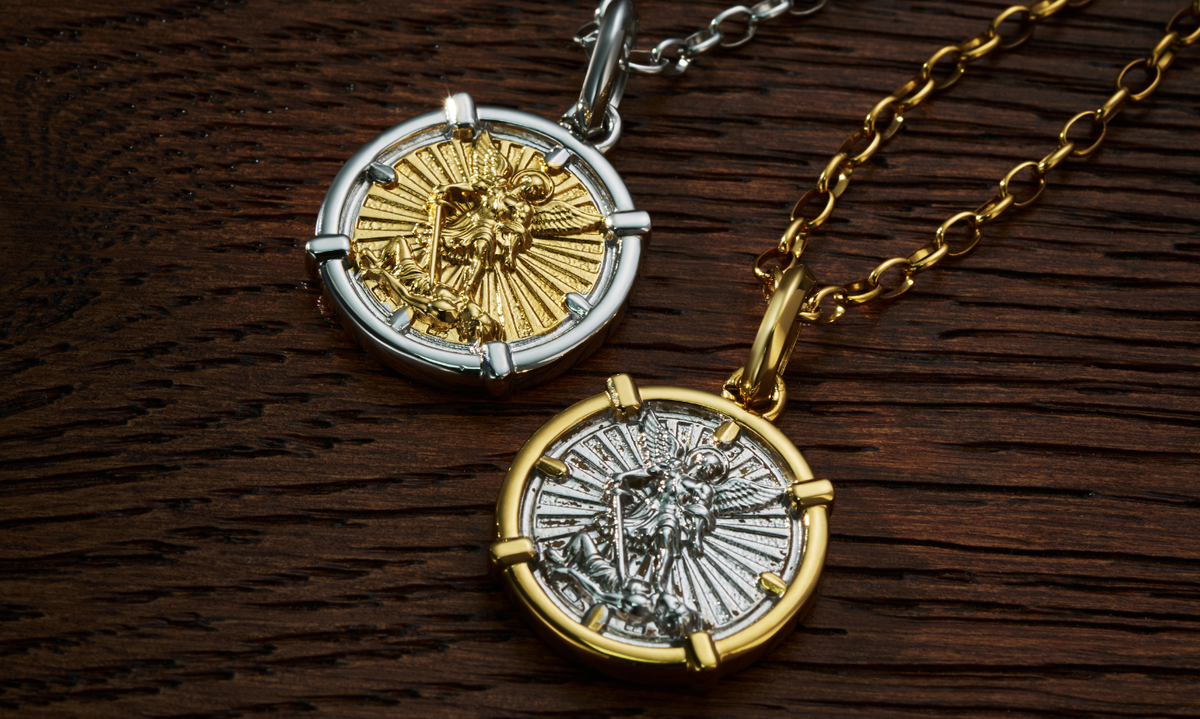
The shortcut: start with a piece that already does it for you. A two-tone piece contains both metals in one object, which means it validates everything else you're wearing — nothing can look accidental next to a piece that's deliberately both. Our Angel pendant is the subtle version of this: a silver piece with a small gold detail held at the chest. It's quiet enough to wear on its own without reading as a statement, and it's the easiest possible bridge if you want to start mixing without committing to a bold split.
One practical caution. Sterling silver is softer than stainless steel and plated gold, so in a tight stack the harder pieces will abrade the softer one over time. Give a mixed stack a little room, or accept that the silver will pick up character faster than the rest.
And the real payoff: once you're mixing, your collection stops being two separate wardrobes. Every piece works with every other piece. Whatever you buy next goes with what you already own, regardless of colour, which is a much better position to be in than owning half a range.
Most writing on this topic is aimed at women, so a few things worth saying for men's pieces in particular.
Silver is the easier starting point. It's less noticeable, works with almost any wardrobe, and is more forgiving if you're not used to wearing jewellery. If you've never worn a chain, a silver one at a modest width is the least conspicuous way in, and you'll stop noticing it within a week.
Gold makes a statement whether you intend it or not. That's not a warning — it's the point of it. Gold sits closer to the tradition men's jewellery actually comes from, from hip-hop to Mediterranean gold chains to signet rings, and it carries weight. If you want jewellery that reads as a deliberate part of your look rather than a detail, gold gets you there faster.
Skin, hair and stubble all factor in more than the vein test does. Darker hair against silver gives you crisp contrast. Warmer complexions and dark hair carry gold effortlessly. Grey hair sits beautifully with silver and steel.
And width matters more than metal. A gold chain at 2mm is more understated than a silver one at 8mm. If you're worried gold is too much, the answer is usually a narrower gauge rather than a different colour. Types of men's chains goes through how the style and width change the effect.
If you're starting out, this is the order that gives you the most range for the least money.
One: your everyday chain, in whichever metal you tried on and preferred. This becomes your default and you'll wear it most. Get the width right — it matters more than the colour.
Two: a ring or bracelet in the same metal. Now you have coherence. Two pieces in one metal is a look rather than an accessory.
Three: your first piece in the other metal. A bracelet or a ring rather than a chain, since it's a lower-stakes place to test the second colour. This is the piece that opens everything up.
Four: a second piece in that other metal. Now you can mix properly, because you can satisfy the repeat-it-twice rule in either direction. From here every combination is available to you.
Four pieces, two metals, and a collection that gives you far more looks than four pieces in one metal ever would. That's the argument for not choosing.
Most of our range comes in both, which is the whole reason the try-it-in-both approach works.
Silver means genuine 925 sterling silver for a real precious metal, or a solid 316L stainless steel core finished in rhodium for the look with almost no upkeep at all — and because steel is silver-coloured and inert to begin with, there's nothing waiting underneath that finish that would ever look wrong.
Gold means real 18 carat gold over a solid stainless steel core, with rhodium beneath it rather than the nickel much of the industry uses, or gold vermeil over solid sterling silver for a precious metal underneath. The full men's gold jewellery range covers both.
Same chains, same pendants, same rings, two finishes. Find the piece, then pick the metal — or take both and mix them.
Both suit most people, so the better approach is to pick the piece you want first and look at it in both metals. If you genuinely can't choose, match whichever metal your watch and existing pieces are, since coherence is what makes jewellery look considered.
Colour and construction. Silver reads cooler and more understated, gold warmer and more deliberate. More importantly, silver pieces are usually sterling or steel, while gold pieces are often a gold layer over a core, and that difference decides how a piece ages.
It's a real effect but a weak one, and it's stated far more firmly than it deserves. Cool undertones do suit silver and warm undertones gold, but most men are neutral and suit both, and contrast can be as flattering as harmony. Use it as a tiebreak rather than a rule.
Yes, and it's now one of the clearest signs someone dresses deliberately. The rule that makes it work is to repeat each metal at least twice, so it reads as a choice rather than a mismatch, and to let one metal dominate rather than splitting evenly.
It depends on construction rather than colour. Stainless steel lasts longest and asks for almost nothing. Sterling silver lasts indefinitely but tarnishes and needs polishing. Gold over a stable core lasts years; thin gold over brass doesn't.
Neither, but silver is the easier starting point if you're new to wearing jewellery, because it's less conspicuous and works with almost any wardrobe. Gold makes more of a statement, which is the reason to choose it rather than a reason to avoid it.
Gold, for the same piece, because gold is a far more valuable material. That gap holds whether the gold is solid, vermeil or plated, since even a plating adds cost over a bare steel or sterling piece.
They need different things. Sterling silver tarnishes and takes a couple of minutes with a polishing cloth. Gold doesn't tarnish, but a gold surface layer can wear, so it wants keeping out of chlorine and away from harsh cleaning products. Stainless steel needs almost nothing.
Both are fine when they're well made. Sterling silver is usually alloyed with copper, which very few people react to, and stainless steel releases very little nickel. On gold, what matters is what sits under the plating rather than the gold itself, since gold is inert and almost nobody reacts to it.
Check the hallmark and the product page. Solid gold carries a fineness mark such as 375, 585 or 750. A gold-coloured piece stamped 925 is gold vermeil, since it's carrying the hallmark of the sterling silver underneath. Anything described as gold plated is a coating over a base metal.
Silver or gold is the wrong question asked in the right direction. The useful version is: which piece do you want, and which of the two does it look better in on you?
Try it both ways, trust what you see, and don't treat the answer as permanent. The men whose jewellery looks best aren't the ones who picked a side. They're the ones who worked out what suits them, then stopped worrying about the rule.
Have a look through the sterling silver collection and the men's gold jewellery range side by side, or read what gold represents if you want the case for gold specifically.
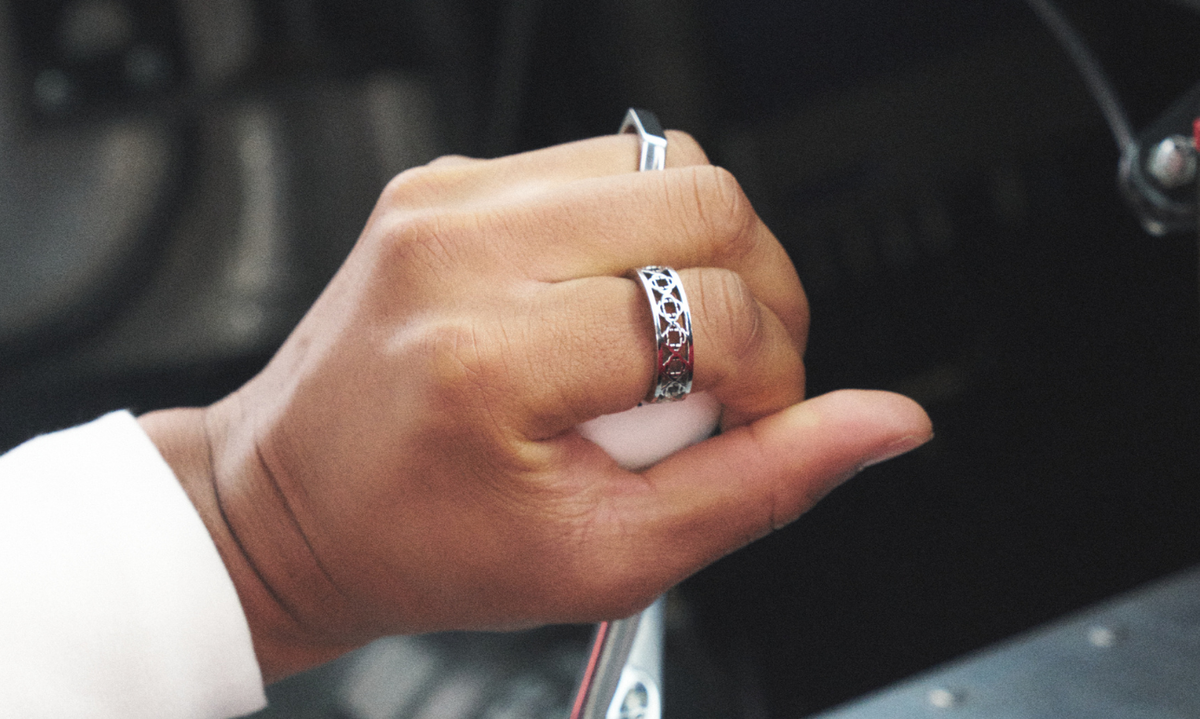
What Is White Gold? (And Why It Isn't Actually White)
White gold isn't white. It's yellow gold alloyed pale and then coated in rhodium, and that one fact explains the price, the carat trade-off, and why it turns faintly yellow after a few years.
Read more
Symbols Stamped on Jewellery: What Every Mark Means
The marks stamped inside a ring are the only part of a piece that has to tell the truth. Here's what every number and letter means, how to read a full British hallmark, and what to do when there's ...
Read more

Leave a comment
This site is protected by hCaptcha and the hCaptcha Privacy Policy and Terms of Service apply.