
GIFT SETS
SHOP NOW

Popular searches

Cart
Your cart is empty
Your gifting options
Make your gift extra special with our luxury packaging options. Select a gift bag, gift box or a combination to create the perfect presentation.

Luxury Gift Box, Gift Bag & Wrapping Kit (99,00 kr)

Meaning Card (28,00 kr)
Add more meaning to your gift with a meaning card included with your order.
15 variations available

Gift Bag, Ribbon & Wrapping (66,00 kr)
The full CRAFTD gifting experience.
Includes: Premium CRAFTD gift bag, Ribbon & Wrapping Paper.
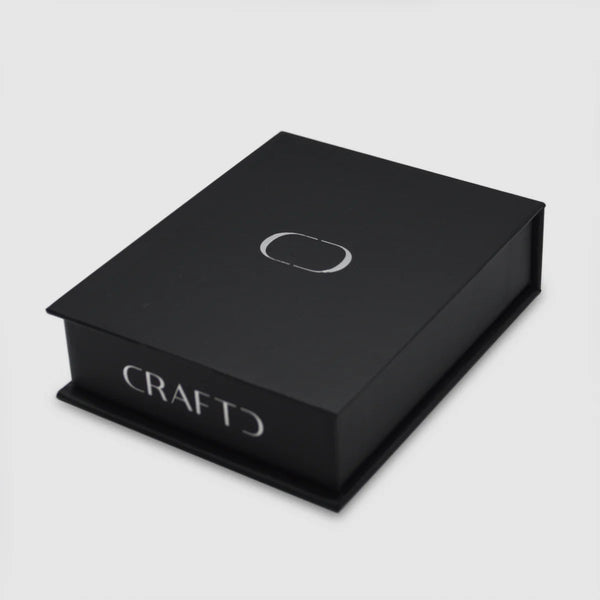
Luxury Gift Box (66,00 kr)
Choose your option
To My Boyfriend

To My Husband

To My Soulmate

To My Grandson

To My Brother

To My True Friend

To My Dad

A Symbol Of Strength

A Symbol of Luck

A Symbol Of Safe Travel

A Symbol Of Self Belief

A Symbol Of Adventure
A pocket watch is worn on a chain, with one end secured to your clothing and the watch itself in a pocket. The chain is what stops you dropping it, and where you anchor that chain is what changes the whole look.
There are five arrangements worth knowing. One is the traditional waistcoat method, and the other four are how you wear one when you aren't dressed like it's 1890.
Jump to:
Worth two minutes, because the instructions make far more sense once you know what things are called.
So a typical setup is: watch, clipped to one end of an Albert chain, with the T-bar at the other end anchored to your clothing.
The original method, and still the one that looks most correct with a three-piece suit.
Push the T-bar through a waistcoat buttonhole, usually the third or fourth down, so it sits horizontally behind the buttonhole and won't pull back through.
Put the watch in the waistcoat pocket on the opposite side. The chain then runs across the front of the waistcoat in a shallow curve, which is the look you're after.
Which side? Traditionally the watch sits in the pocket on the opposite side to your dominant hand, so you draw it across your body with your writing hand. If you're right-handed, that means the left pocket. It's a convention rather than a law, and comfort beats tradition.
The chain should curve, not sag. A slight dip is right. If it hangs low enough to swing when you move, the chain is too long.
The most practical modern method, and the one most people are actually looking for.
Clip or loop the chain to a belt loop, usually the one nearest your front pocket. Some Albert chains have a clip that does this directly, and others need a small spring clasp adding.
Put the watch in your front trouser pocket. If your jeans have the small coin pocket inside the right front pocket, that's almost exactly what it was designed for, and it holds a watch beautifully.
Let a short length of chain show between the belt loop and the pocket opening. That visible loop is the entire point. Too much and it catches on things, too little and nobody knows it's there.
This works with jeans, chinos and workwear, and it's the version that looks deliberate rather than costume.
Good with a blazer or an overcoat when there's no waistcoat involved.
Anchor the T-bar to the buttonhole on the lapel, or to an inside pocket, and rest the watch in the breast pocket or an inside pocket.
This is the most discreet of the five. Very little chain shows, which suits it to smarter settings where you'd rather the watch was noticed when you take it out than before.
If your trousers have no belt loops, or you're not wearing a belt, you have two options.
Use a trouser button or a waistband tab as the anchor point for the T-bar, if there is one.
Or use a chain with a clasp at both ends and clip it to the pocket edge itself. It's less secure than a buttonhole, so it suits sitting still more than moving about.
Honestly, this is the least reliable arrangement, and if you're going to be on your feet the belt loop method is better.
The version with two chains meeting at a central T-bar, and it's the one people ask about after they've seen one.
The T-bar goes through a central waistcoat buttonhole. The watch clips to one chain and hangs in the pocket on that side. The second, shorter chain carries a fob on the other side: a medallion, a seal, a coin, or in the past a key for winding the watch.
It's more decorative than a single Albert and reads as considerably more formal. Wear it with a waistcoat or not at all.
The chain matters more than most people expect, because it's the part that's visible almost all the time.
On style, the Albert is a curb chain at heart, which is the same flattened, interlocking link you'll find on plenty of modern jewellery. That family also gives you the Figaro, with its repeating short and long links, and the rope, with its twisted texture. If you want the chain to sit comfortably alongside other pieces you wear, staying within one family is the easy way to do it. Our guide to types of men's chains goes through how each style behaves.
On length, the principle is the same one that governs any chain: it should sit where you want it, and the way to get that right is to measure rather than guess. Too long and it swings, too short and it pulls when you sit down. Our chain length guide covers the measuring method, which transfers directly.
On metal, match the chain to the watch case rather than to the rest of your jewellery. A silver-cased watch on a gold chain looks like two things that arrived separately. If you're deciding between the two more broadly, silver or gold jewellery covers how to choose.
Three case styles, and the difference is simply how much metal is between you and the dial.
Open face. No cover at all. The dial is under glass and visible at a glance, which makes it the quickest to read and the most exposed to knocks.
Full hunter. A hinged metal cover over the dial, opened with a press of the crown. Named for fox hunting, where riders wanted a watch they could open one-handed while holding the reins. Maximum protection, and you have to open it to read the time. You'll also see it called a savonnette, from the French for a cake of soap, which is roughly what the closed case looks like.
Half hunter. The useful compromise, and the one most often described wrongly. It has a metal cover like a full hunter, but with a circular window cut into the middle of it, so you can read the hands through the hole without opening the case. The hour numerals are usually printed around the outside of the cover. Protection of a hunter, speed of an open face.
If you're buying rather than inheriting, a half hunter is the most practical of the three for actual daily use.
1. The chain is not decoration, it's insurance. Always anchor it. A pocket watch dropped onto a hard floor is usually a repair job.
2. Keep it in a pocket of its own. Keys and coins in the same pocket will scratch a case in a week.
3. Wind it at the same time each day if it's a manual movement, which most older ones are. Wind gently and stop as soon as you feel resistance.
4. Don't let it swing. A chain that arcs when you walk is too long, and it will catch on a door handle eventually.
5. Take it off before anything physical. It's the least practical watch ever made, which is part of the charm, but it's not a sports watch.
6. One statement at a time. A pocket watch is already doing plenty of work. It doesn't need to compete with a stacked wrist on the same side.
If you've inherited one, this is the most interesting five minutes you'll spend with it.
British pocket watch cases in silver or gold are hallmarked, and unlike most jewellery a full hallmark includes a date letter, which changes every year. So the case can usually be dated to a specific year, and attributed to the Assay Office that tested it: a leopard's head for London, an anchor for Birmingham, a rose for Sheffield, a castle for Edinburgh.
Look inside the case back, where the marks are usually struck. You'll typically find a sponsor's mark, a fineness mark such as 925 for sterling silver or 375 for 9 carat gold, the office mark and the date letter.
Worth knowing that the case and the movement are often separate. Cases were frequently made by one firm and movements by another, so a case hallmark dates the case rather than necessarily the watch inside it.
Our guide to symbols stamped on jewellery is the full key to reading those marks.
On a chain, with one end anchored to your clothing and the watch in a pocket. The traditional method is a T-bar through a waistcoat buttonhole with the watch in the opposite waistcoat pocket. The most practical modern method is clipping the chain to a belt loop with the watch in your front trouser pocket.
Five that work: through a waistcoat buttonhole, clipped to a belt loop with jeans, anchored to a lapel or inside pocket with a jacket, attached to a trouser button or pocket edge when there's no belt loop, and as a double Albert with a fob on the second chain.
Traditionally the waistcoat pocket on the opposite side to your dominant hand, so you draw it across your body. With jeans, the small coin pocket inside the right front pocket is almost exactly the right size.
Yes, and it's the most common way now. Clip the chain to the belt loop nearest your front pocket, put the watch in that pocket, and leave a short length of chain visible between the two.
The standard pocket watch chain, named after Prince Albert. A single Albert has a T-bar at one end for a buttonhole and a clip at the other for the watch. A double Albert has two chains meeting at a central T-bar, with a watch on one side and a decorative fob on the other.
A full hunter has a solid metal cover over the dial that you open to read the time. A half hunter has the same metal cover with a circular window cut into the centre, so you can see the hands without opening it. An open face watch has no cover at all.
Yes, and the methods are identical. The belt loop and jacket pocket arrangements work with most clothing, and there's a long history of pocket watches worn on a chain around the neck as a pendant.
Give it a pocket to itself, away from keys and coins, and use a hunter or half hunter case if it's going to see daily use. The cover exists precisely because dials get scratched.
Most older ones are manual movements and want winding roughly every 24 hours, ideally at the same time each day. Wind gently and stop as soon as you feel resistance rather than forcing it.
A pocket watch is worn on a chain, anchored at one end, with the watch in a pocket. Everything else is a variation on where you anchor it.
The waistcoat method is the traditional one and the belt loop method is the one you'll actually use. Both come down to the same thing: the chain should be short enough not to swing, and visible enough to be seen.
If the chain is the part you're thinking about, types of men's chains covers the styles the Albert belongs to, and symbols stamped on jewellery will tell you how to read the marks on an old case.
Men's Jewellery Trends: What Lasts and What Doesn't
In 2021 we called six men's jewellery trends. Four held, one faded, one changed shape entirely. Here's what actually lasted, and the pattern that explains why.
Read more

Leave a comment
This site is protected by hCaptcha and the hCaptcha Privacy Policy and Terms of Service apply.