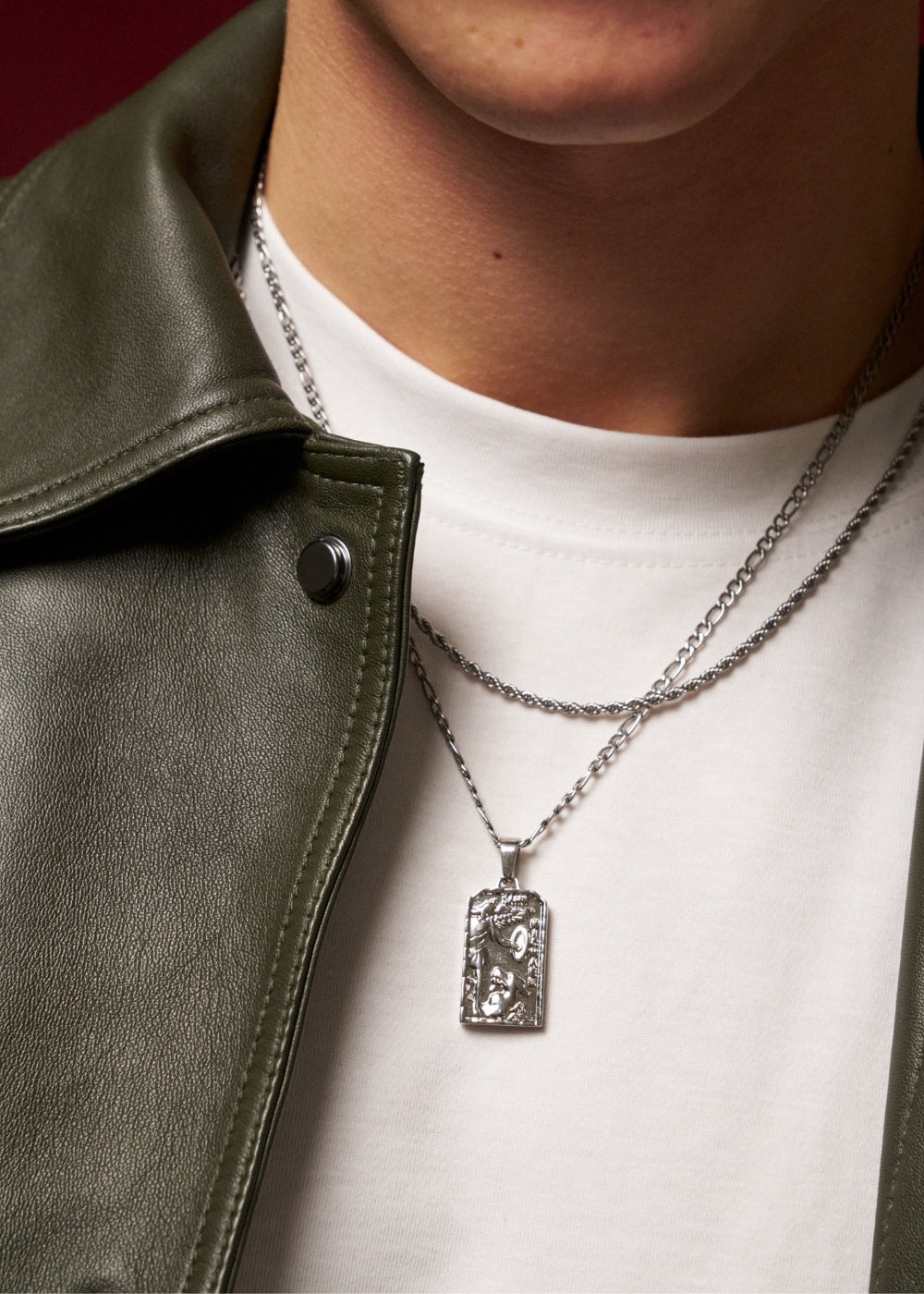
COLLARES DE PLATA
COMPRA AHORA


A necklace looks like one piece. It's actually five or six, working together. There's the chain, the clasp that closes it, the tiny rings that join everything up, and, if you wear a pendant, the bail that holds it in place.
Most people never need the names. But the moment you're choosing a chain for a pendant, buying one as a gift, or trying to work out why something keeps coming undone, knowing the parts makes the whole thing simpler. Here's every part of a necklace, what it's called, and what it actually does.

A pendant, a bail and a chain: the three parts most necklaces are built from. Featured: the Compass pendant.
Jump to:
Not every necklace has every part. A plain chain has four. A pendant necklace adds two more. Here's the full list, in the order you'd find them.
| Part | What it is | Where you'll find it |
|---|---|---|
| Chain | The linked length of metal that goes around your neck | Every chain and pendant necklace |
| Clasp | The fastening that opens and closes the necklace | At the back of the neck |
| Jump ring | A small metal ring that joins two parts together | Between the clasp and the chain |
| End ring | The loop or tag the clasp hooks onto | The opposite end of the chain from the clasp |
| Pendant | The piece that hangs from the chain | The front of a pendant necklace |
| Bail | The loop that holds the pendant on the chain | The top of the pendant |
| Extender | A short extra length of chain for adjusting the fit | Next to the clasp, on some necklaces |
| End caps | Metal caps that finish the ends of a cord or strand | Cord, bead and some pearl necklaces |
The chain is the foundation. Everything else hangs off it, fastens to it or finishes it. Wear one on its own and it's the whole look. Add a pendant and it becomes the frame.
A chain is simply a run of links joined one to the next, and the way those links connect is what gives each style its name and character. A Cuban uses interlocking oval links that are twisted to lie flat. A rope twists its links into a spiral. A box chain uses square links that give it a clean, structured line. Our guide to types of men's chains goes through every style properly.

The chain is the foundation. Featured: the 2mm Connell chain.
Three things about the chain decide how a necklace looks and wears:
Not sure which length is right? Our chain length guide shows where each length sits on the body.

Width and link style change how a chain sits. Featured: the 4mm Cuban chain.
Not every necklace uses a metal chain. A cord necklace swaps the chain for leather, waxed cotton or braided thread, which gives a softer, more handmade look. A strand is a line of beads or pearls threaded onto a strong cord or wire, which is how pearl necklaces are made. Both still need a way to close, and both usually finish with end caps or knots rather than an open link.

A strung necklace: pearls on a thread, closed with a clasp. Featured: the Rounded Real Pearl Necklace.
Our Rounded Real Pearl Necklace is a good example: real freshwater pearls, hand-strung, and finished with an adjustable lobster clasp that sits anywhere between 48cm and 53cm. For more on how pearl pieces are made and worn, see why men wear pearl necklaces.
The clasp is the fastening at the back of the neck, and it's the part that does the most work. Every time you put a necklace on or take it off, the clasp takes the strain. A good one feels secure the moment it closes. A poor one is the reason chains go missing.

A lobster clasp and end ring. Featured: the 2mm Round Box chain.
These are the types you'll come across most:
Our chains are secured with snap-proof clasps, a lobster clasp on our everyday chains. It's the part we'd least want to cut corners on, because it's the part that keeps the chain on you.

Tennis chains close with a clasp built into the line of stones. Featured: the 3mm Tennis chain.
These are the smallest parts of a necklace, and the ones almost nobody notices until one fails.
A jump ring is a small circle of metal that joins two parts together, most often the clasp to the end of the chain. It has a tiny split so it can be opened and closed. That split is also its weak point: if a necklace is pulled hard, the jump ring is usually what opens first.
The end ring sits at the opposite end of the chain. It's the loop, or sometimes a small flat tag, that the clasp hooks onto. On some necklaces the end ring carries the maker's mark or a metal stamp. Our guide to what 925 means on jewellery explains what those stamps tell you.
Some necklaces also have an extender: a short length of chain fitted beside the clasp, so you can wear the necklace a little shorter or longer. It's useful if you're between lengths, or you want to layer two chains at slightly different heights.
If the chain is the frame, the pendant is the picture. It's the piece that hangs at the front, catches the eye and, more often than not, carries the meaning. A compass for direction. A cross for faith. A Saint Christopher for protection on the road.

The pendant, and the bail that joins it to the chain. Featured: the Compass pendant.
You'll hear a few words used for the same idea:
Most of our pendants come with the chain included, so they're ready to wear the moment they arrive. The Compass, for example, hangs from a 3mm link chain on a premium silver bail. For the story behind the most popular symbols, see our guides to the Compass necklace and the most powerful religious pendants for men.
This is the part most people can't name, and the one they search for most. The bail is the loop, ring or tube fixed to the top of a pendant. The chain runs through it, and it's what holds the pendant on the necklace.

A hidden bail keeps the focus on the pendant. Featured: the Angel pendant.
It sounds like a small detail, but the bail decides two things: how the pendant hangs, and which chains it will fit. The main types are:
Our Angel pendant uses a hidden silver bail, so nothing interrupts the carved figure. The Compass uses a visible bail that sits as part of the design.
One thing to check: the opening in the bail has to be wide enough for the chain, and for the clasp to pass through when you thread it on. A heavy chain won't always fit a small pendant, which is why pendants that come with their own chain are the simplest option.
A pendant has its own anatomy too. Not every pendant has every part, but these are the names worth knowing:
When you're choosing a pendant, the face tells you what it means and the setting tells you how well it's made. A stone should sit firmly with no movement, and a carved face should feel crisp rather than soft around the edges.
Knowing the parts makes it easy to spot a necklace that's built to last. Before you buy, check five things:
If a chain ever does knot around its own clasp, our guide on how to untangle a necklace covers every method that works.
Necklaces are among the oldest jewellery we know of. The earliest were strands of shells, beads, teeth and bone, tied with cord, with no clasp at all. Metal chains came much later, and by the Middle Ages gold chains hung with pendants and set with gemstones had become a sign of status and wealth.
Most of the parts we use today, like the jump ring, the bail and the spring-loaded clasp, grew out of one simple need: to make a necklace easy to put on and hard to lose. That's still the test worth applying to anything you buy.
Most necklaces are built from a chain (or a cord or strand of beads), a clasp that opens and closes it, jump rings that join the parts together, and an end ring the clasp hooks onto. Pendant necklaces add a pendant and a bail, the loop that holds the pendant on the chain. Some also have an extender or end caps.
It's called a bail. The bail is the loop, ring or tube fixed to the top of the pendant, and the chain passes through it. A hidden bail sits behind the pendant so you can't see it from the front.
The bail. The opening inside it has to be wide enough for the chain, and in particular for the clasp to pass through, which is why a heavy chain won't always fit a small pendant.
The fastening is called a clasp. The most common type is the lobster clasp, a small spring-loaded hook shaped like a lobster's claw. Others include the spring ring, box clasp, toggle, hook and magnetic clasp.
The back of a necklace is usually just called the clasp or the closure, since that's where it opens. The small loop or tag the clasp hooks onto is called the end ring.
A pendant hangs on its own, usually from a bail, and is the focal point of the necklace. A charm is smaller and often one of several, usually attached with a jump ring. In practice the words overlap, but a single statement piece on a chain is a pendant.
A jump ring is a small metal ring that joins two parts together, for example the clasp to the end of the chain. It's the part most likely to open if a necklace is pulled hard, so it's worth checking it's closed tight.
An extender is a short length of chain fitted at the clasp end, so you can wear the necklace a little longer or shorter. It's useful if you're between lengths or want to layer two chains at different heights.
Once you know the parts, choosing a necklace gets simpler. Start with the chain, because it does the most work, then decide whether it needs a pendant to finish it.
Explore our men's chains and men's pendants, or read our guide to the best chains for men to find the one that suits you.

Coloured Pearls: What Makes Pearls Different Colours?
Not every pearl is white. Pearls grow naturally in pink, gold, grey and black, and some colours are dyed. Here's what gives a pearl its colour, and how to tell the difference.
Leer más
Types of Earrings for Men: Every Style, and How to Wear It
Studs, hoops, huggies or a charm hoop? Here's every type of men's earring explained, which ear to wear it in, whether to wear one or two, and how to pick your first pair.
Leer más


Dejar un comentario
Este sitio está protegido por hCaptcha y se aplican la Política de privacidad de hCaptcha y los Términos del servicio.