COLLARES DE PLATA
COMPRA AHORA


Cesta
La cesta está vacía
Your gifting options
Haz que tu regalo sea aún más especial con nuestras opciones de embalaje de lujo. Selecciona una bolsa de regalo, una caja de regalo o una combinación para crear la presentación perfecta.

Caja de Regalo de Lujo, Bolsa de Regalo y Kit de Envoltura (€8,99)

Tarjeta de significado (€2,50)
Añade más significado a tu regalo con una tarjeta con mensaje incluida en tu pedido.
15 variations available

Bolsa de Regalo, Cinta y Envoltura (€5,99)
La experiencia completa de regalo CRAFTD.
Incluye: Bolsa de regalo CRAFTD premium, cinta y papel de regalo.

Caja de Regalo de Lujo (€5,99)
Choose your option
Para Mi Novio

Para Mi Esposo

A Mi Alma Gemela

Para Mi Hijo

Para mi nieto

Para Mi Hermano

A Mi Verdadero Amigo

Para mi papá

Un Símbolo De Fuerza

Un Símbolo De Fe

Un símbolo de protección

Un símbolo de suerte

Un símbolo de viaje seguro

Un Símbolo De Creencia En Uno Mismo

Un símbolo de aventura
Artículo: St Benedict Pendant Meaning: The Story Behind the Letters
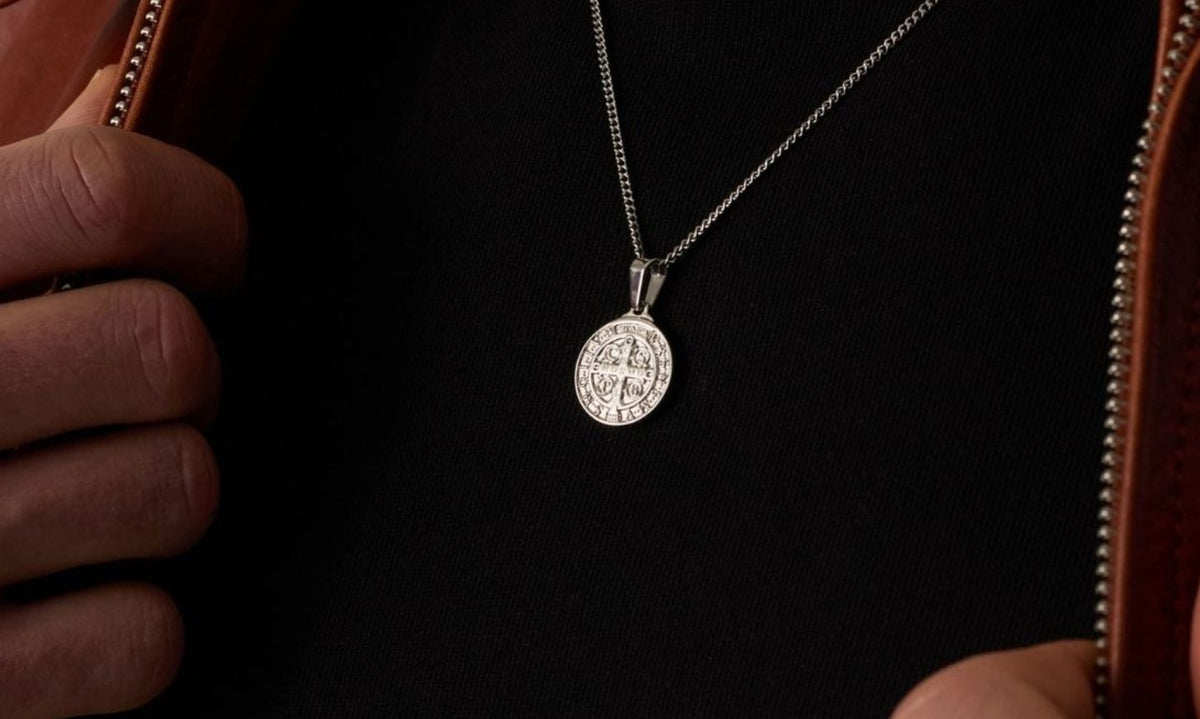
A St Benedict pendant carries a cross ringed with Latin initials, and each set of letters opens a short prayer for protection and for the strength to turn temptation away. Few protective designs in Christian jewellery are older, and few look more puzzling at first glance, because the letters read like a code until someone spells them out.
So we've spelled them out. Below you'll find every letter decoded, the stories that gave the design its symbols, a fair answer on who can wear one, and how our pendant and band ring carry the same words into everyday wear.

The cross and its ring of initials, struck in fine relief. Featured: Saint Benedict (Gold).
Jump to:
Benedict was born around the year 480 in Nursia, the town now called Norcia, in the hills of central Italy. Sent to Rome to study, he walked away from the city's distractions and spent about three years living alone in a cave at Subiaco. Word of the young hermit spread, followers arrived, and he went on to found a string of small monastic communities. Around 529 he built his best-known house on the hilltop of Monte Cassino, between Rome and Naples, where he died in about 547.
His lasting legacy is a short book known as the Rule of St Benedict: a practical guide to living together that balances prayer, work, study and rest. Monasteries still follow it fifteen centuries later, and in 1964 Pope Paul VI named Benedict a patron saint of Europe.
Almost everything we know about his life comes from Pope Gregory the Great, who wrote it down a few decades after Benedict's death. That account is also where the symbols on the pendant come from.
The traditional design has two faces. One shows Benedict himself, holding a cross and his Rule. The other, the side on our pendant, is a cross surrounded by initials. Each group of letters is the start of a Latin phrase:
| Letters | Latin | In English |
|---|---|---|
| C S P B | Crux Sancti Patris Benedicti | The cross of the Holy Father Benedict |
| C S S M L | Crux Sacra Sit Mihi Lux | May the holy cross be my light |
| N D S M D | Non Draco Sit Mihi Dux | Let not the dragon be my guide |
| V R S | Vade Retro Satana | Get behind me, Satan |
| N S M V | Numquam Suade Mihi Vana | Never tempt me with empty things |
| S M Q L | Sunt Mala Quae Libas | What you offer is evil |
| I V B | Ipse Venena Bibas | Drink the poison yourself |
On most versions they're laid out the same way. C S S M L runs down the upright of the cross and N D S M D runs across the beam, so the two lines meet in the middle. C S P B fills the four corners between the arms. The two rhyming couplets, V R S N S M V and S M Q L I V B, travel around the rim, usually starting at the top. Many designs also add the word PAX, meaning peace, above the cross.
Read together, it's a short exchange: a prayer for light, a refusal to be led by evil (the dragon is an old Christian image for the devil), and a firm instruction to take the temptation back. The dragon line is the one we engrave on our pieces, because it sums up the rest in six words.

Tilt it towards the light and the letters come forward. Featured: Saint Benedict (Gold).
Two stories from Gregory's account explain the pictures that sit alongside the letters on the traditional design.
The rhyming prayer around the rim is far younger than Benedict. The usual account places it in Bavaria in 1647, when women on trial for witchcraft near Metten Abbey reportedly claimed they had no power over the abbey because it was protected by the cross. Monks found crosses painted with these initials on the abbey walls, and the meaning of the letters was traced to a much older manuscript in its library.
The design spread quickly after that. Pope Benedict XIV gave it formal approval in 1742, and the version most people recognise today was produced at Monte Cassino for the 1,400th anniversary of Benedict's birth in 1880.
There are two honest answers, and both are worth hearing.
In Catholic practice it's a sacramental: an object, usually blessed by a priest, worn as an aid to prayer rather than as a lucky charm. Many Catholics have theirs blessed when they first get it and say the words on it as part of their day. From that point of view, wearing it is an act of faith, not a style choice.
Plenty of people outside the Church wear one too, drawn to what the letters actually say: a promise to yourself not to take the easy road, and to keep heading the right way. Nobody needs permission for that, but it's worth knowing the prayer you're carrying and handling it as carefully as any cross.
If you're Catholic, ask your parish priest about a blessing. If you're not, wear it knowing what it means. Either way, the message holds. For the wider picture of faith pieces and what each one signals, see the meanings behind men's religious pendants.
Our Saint Benedict (Gold) and Saint Benedict (Silver) pendants show the lettered cross on a round 15mm face, hung from a bail on a 51cm Cuban chain 2mm wide. Each starts as 316L stainless steel and is then plated in gold or rhodium, which keeps the fine relief of the letters crisp. At that size it sits tidily at the collarbone, and it tucks under a shirt when you'd rather keep it private.

Small enough to sit quietly over a plain tee. Featured: Saint Benedict (Gold).

Silver against dark layers keeps it understated. Featured: Saint Benedict (Silver).

Rhodium over steel, for a bright silver finish that holds its detail. Featured: Saint Benedict (Silver).
The Saint Benedict Band Ring (Gold) and Saint Benedict Band Ring (Silver) take the cross and repeat it: eight round medallions joined into one unbroken band, with the dragon line engraved as a hidden inscription. The inner shank is brushed, so it feels comfortable straight away, and it's available in S, M or L.
A pendant tends to be private, close to the chest. The ring puts the cross on your hand, where you'll see it many times a day, and for some men that's the appeal. For how it compares with plainer bands, see our band ring guide, or browse the full set of band rings.

Eight medallions joined into one closed band. Featured: Saint Benedict Band Ring (Gold).

The medallion edge gives the band a softly scalloped outline. Featured: Saint Benedict Band Ring (Gold).

In silver, the cross on each medallion reads clearly. Featured: Saint Benedict Band Ring (Silver).

A hidden inscription carries the dragon line with you. Featured: Saint Benedict Band Ring (Silver).
The St Benedict cross is busy with detail, and looks best when the pieces around it are simpler.
For the drop, see how each chain falls on the body in our length guide.

Alone on the hand, it says everything it needs to. Featured: Saint Benedict Band Ring (Silver).
Because the pendant and ring are plated 316L stainless steel, everyday water is fine: shower in them and don't worry about the rain. Remove them before you swim in a pool or the sea, or sit in a hot tub, since chlorine and seawater gradually wear plating thin. Our guide to plated jewellery and water explains why.
The letters are what this piece is about, so look after the relief:
In Catholic tradition it asks for protection from evil and temptation, and for strength at the hour of death. It isn't treated as a charm that works on its own; the protection is sought through the prayer written on it.
Catholics who wear it as a devotional object usually ask a priest to bless it. If it's a personal reminder for you rather than a devotional object, you can wear it without one.
It stands for Crux Sancti Patris Benedicti, Latin for "the cross of the Holy Father Benedict". The four letters sit in the corners between the arms of the cross.
There's no rule. Traditionally the figure of Benedict is the front, but many people turn the cross outward because that's the side carrying the prayer. Ours shows the cross.
Yes. Put them on different lengths so the two faces don't knock together, and keep the chains similar in weight so neither looks like an afterthought.
Yes. Both pieces are gold or rhodium plating over 316L stainless steel, which copes with a daily shower and a wet commute. Leave them on the side for swimming, whether that's a pool or the sea, and for hot tubs.
Any finger it fits. The middle finger lets the medallions take centre stage, and the right ring finger keeps it clear of a wedding band.
Europe, first of all, along with monks and religious communities, students and farm workers. Because of the poisoned cup story, he's also called on for protection against poison.
Strip away the history and the St Benedict cross comes down to one idea: don't let the wrong thing lead you. That's why it has lasted for centuries, and why it still holds up today, whether it hangs at your collarbone or circles a finger.
See the Saint Benedict pendant and band ring, or explore the rest of our Faith Collection.
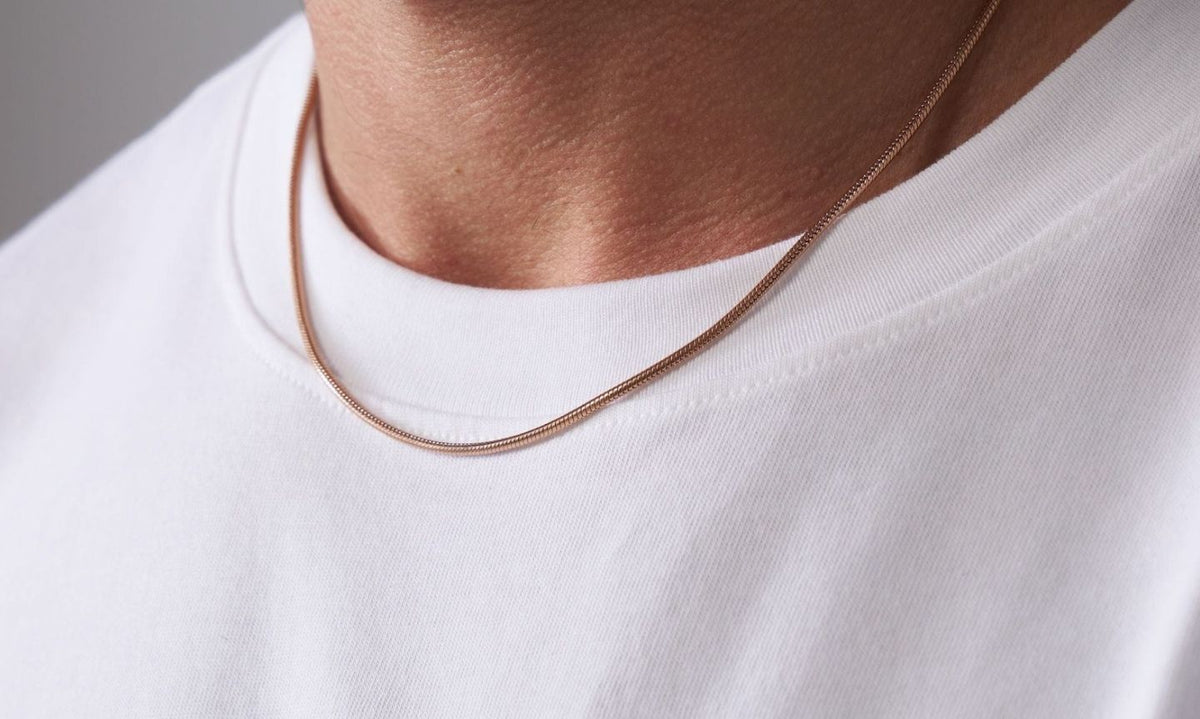
A herringbone chain is a flat run of slanted links that shines like poured metal but bends easily. Here’s how it’s made, how to look after one and the chain we suggest instead.
Leer más


Dejar un comentario
Este sitio está protegido por hCaptcha y se aplican la Política de privacidad de hCaptcha y los Términos del servicio.