
Most gifted
Shop now


Panier
Votre panier est vide
Your gifting options
Sublimez votre cadeau avec nos options d’emballage de luxe. Choisissez un sac cadeau, un coffret ou un assortiment des deux pour une présentation impeccable.

Coffret cadeau de luxe, sac cadeau et kit d'emballage (€9,44)

Carte de signification (€2,63)
Donnez plus de sens à votre cadeau grâce à une carte de signification incluse dans votre commande.
15 variations available

Sac cadeau, ruban et emballage (€6,29)
L'expérience cadeau complète CRAFTD.
Comprend : un sac cadeau CRAFTD de qualité supérieure, un ruban et du papier d'emballage.
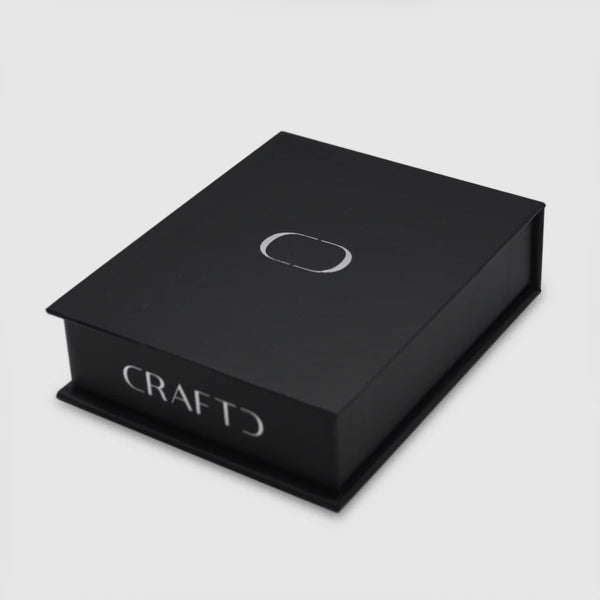
Coffret cadeau de luxe (€6,29)
Choose your option
À mon copain

À mon mari

À mon âme sœur

À mon fils

À mon petit-fils

À mon frère

À mon ami sincère

À mon papa

Un symbole de force

Un symbole de foi

Un symbole de protection

Un symbole de chance

Un symbole de voyage sûr

Un symbole de confiance en soi

Un Symbole d'Aventure

Ask a man where his jewellery came from and you'll probably hear a familiar set of answers. A chain for his 18th. A ring on his wedding day. A watch to mark thirty years at work. Something his partner bought him one Christmas.
For generations, those have been the moments when many men received their first proper pieces of jewellery. Not necessarily because they wouldn't have chosen something themselves, but because jewellery was something you were given to mark an occasion. And for some men, buying a piece for themselves still feels a little strange, almost like writing your own birthday card.
But why should it? We don't think twice about buying ourselves a new jacket, a pair of trainers or something else we've had our eye on. So why does jewellery sometimes feel different? And more importantly, why should someone else get to decide which moments in your life are worth marking?

Chosen by someone else, and that's part of what makes it special.
First, there's a good reason gifts mean so much to us. In 1925, French anthropologist Marcel Mauss published The Gift, a study exploring the role of gift-giving in different societies. One of his central observations was that a gift is rarely just an object. It forms part of a relationship between the person giving it and the person receiving it.
And you don't need to have read his work to understand the feeling. Think about a piece of jewellery someone gave you that genuinely mattered. Maybe it was your first proper chain. A bracelet from someone close to you. A watch you received after reaching a milestone. Chances are, what makes it special isn't just the piece itself. It's remembering who gave it to you, why they chose it and what was happening in your life at the time. Every time you wear it, a little of that comes back.
It's why jewellery remains such a meaningful gift. Some of our most gifted pieces are chosen to celebrate birthdays, relationships and moments that deserve to be remembered. Sometimes, giving someone a chain or a ring is a way of saying something you might struggle to put into words, and there's something about that which buying a piece yourself can't quite replicate.
But that doesn't mean one has to be worth more than the other.
Because here's the problem with waiting for someone else to buy you something: not every achievement comes with a celebration. The promotion nobody made much of a fuss about. The year you finally got yourself out of debt. The business you started without knowing whether it would work. Or simply getting through a period of your life that was harder than anyone around you realised.
These things might not come with a party, a card or a gift waiting at the end. But that doesn't make them any less significant. And if you've worked towards something for months or years, why should you need someone else to decide it's worth celebrating?
There's an interesting point about the way we give gifts, too. In a 2011 study, psychologists Francesca Gino and Francis Flynn found that people often appreciated gifts they'd specifically asked for more than unexpected ones. The people buying the gifts, however, tended to overestimate how thoughtful their unsolicited choices would seem. It's a reminder that the value of a gift isn't always about the surprise. Sometimes, knowing exactly what you want matters just as much.
There's actually a name for the idea of buying something to mark a personal moment. In 1990, consumer researchers David Glen Mick and Michelle DeMoss studied what they called self-gifts. They found that people often bought things for themselves to reward an achievement, recognise a personal milestone or provide comfort during difficult times. These weren't necessarily impulsive purchases. Often, they were deliberate decisions with personal significance: a way of acknowledging something that mattered, even when nobody else was there to acknowledge it.
The jewellery industry has been exploring this idea for years. In 2003, De Beers launched its Right-Hand Ring campaign, encouraging women to see diamond rings as something they could choose for themselves, rather than something that had to be given to them. The thinking was simple. A ring didn't need to represent an engagement or a relationship to be worth wearing. It could represent personal style, independence or an achievement of your own.
There's no reason the same thinking shouldn't apply to men. In fact, it's already becoming more common. A 2025 YouGov survey found that 17% of British men had bought jewellery for themselves in the previous year, rising to 24% among Gen Z. And perhaps that's a good thing.
Because a signet ring you bought after starting your own business can carry just as much personal significance as one somebody gave you. The same goes for a sterling silver chain you picked out after reaching a goal you'd been working towards for years. The fact that you chose it yourself doesn't take anything away from the achievement. If anything, it means you know exactly why you bought it.

When you choose it, you know exactly why.
Of course, not everything you buy has to celebrate a milestone. Sometimes you see a chain you like. You try on a ring and it feels right. You find something that suits your style and decide you'd like to own it. That should be enough, too.
We've already explored whether every piece of jewellery needs a meaning, and the same principle applies here. You don't need to invent a reason for wanting something. There's nothing wrong with rewarding yourself for a personal achievement, but there's equally nothing wrong with buying a piece simply because you like it. And you certainly don't need to wait until Christmas or your birthday.
That's something we've always believed at CRAFTD. Our Back Yourself philosophy is about recognising your own worth, trusting your decisions and taking pride in the direction you're heading. Sometimes that means celebrating something you've achieved. Other times, it means being comfortable choosing something for yourself, without needing anyone else's approval. Neither has to be a grand statement.
None of this means a piece someone gives you is any less special. There's something irreplaceable about wearing jewellery that connects you to another person: a chain from your dad, a ring from your partner or something you were given at a moment you'll never forget. Those pieces carry memories that no amount of money can recreate.
But the pieces you choose for yourself can carry memories, too. One might remind you of someone who believed in you. Another might remind you of a time when you had to believe in yourself. And another might simply be a piece you love wearing. There's room for all three.

Given or chosen, both get worn.
Because ultimately, what makes jewellery worth keeping isn't whether you bought it yourself or found it waiting inside a gift box. It's the place it earns in your life. Some pieces remind you that someone else thought you were worth celebrating. Others remind you that you thought so, too.
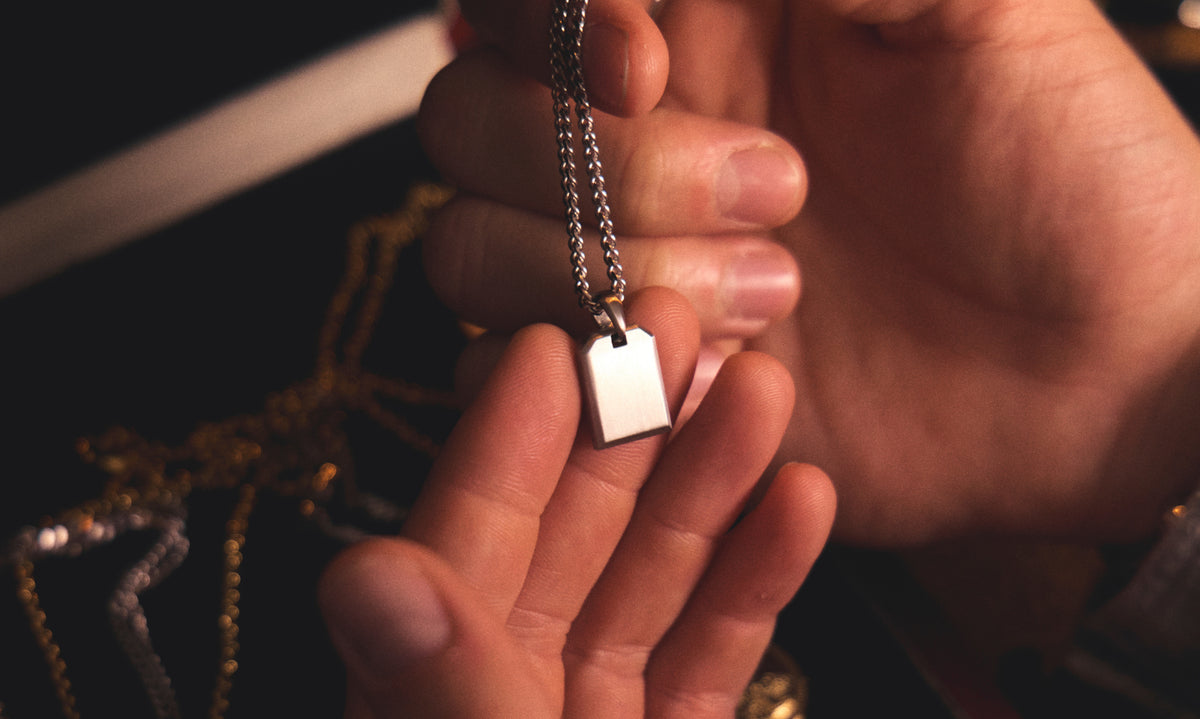
Do British Men Play It Too Safe With Style?
Ever taken a chain off before leaving the house in case someone says something? When British understatement is style, and when it’s just fear.
En savoir plus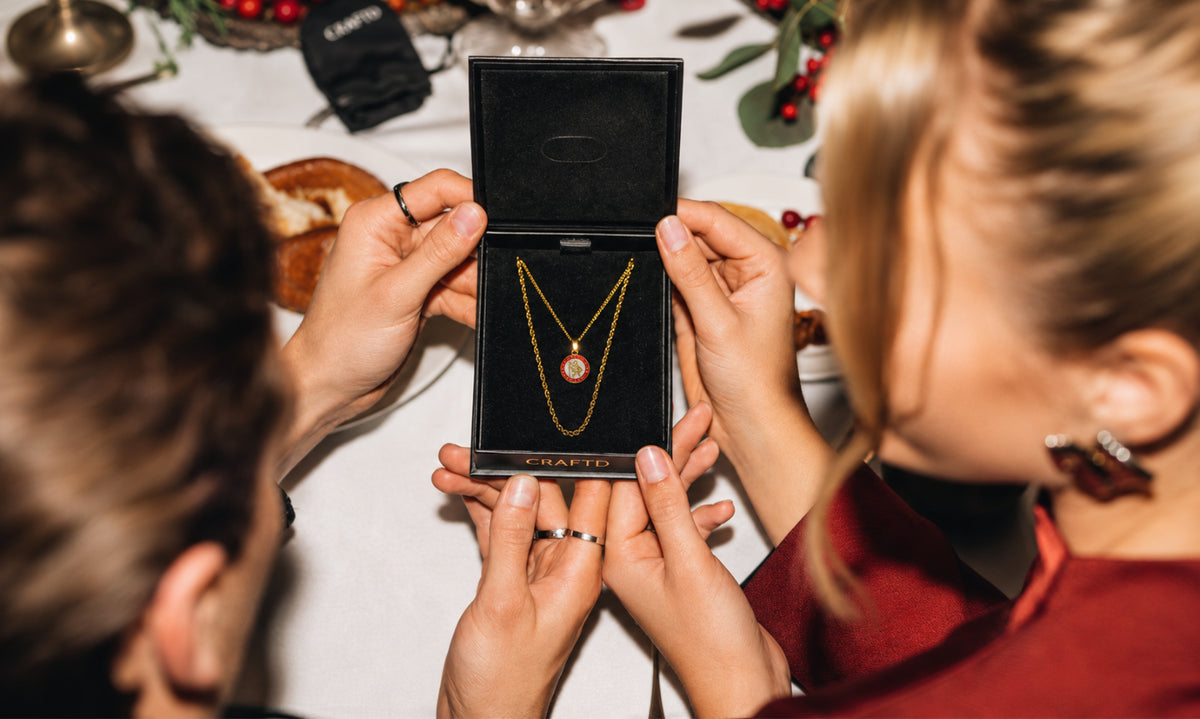
Why Your First Piece of Jewellery Means So Much
Your first chain. A watch for your 18th. A ring bought with your first pay packet. Some pieces stay with us long after the moment has passed. But what makes that first one so special?
En savoir plusCommon searches
Top selling products

 Ready to give.
 Hand-finished chains.
 Pendants with meaning.
 Neck and wrist, done.
 The clover collection.
 Créez votre propre ensemble (or)
 Créez votre propre ensemble (argent)
 Fabriquer un ensemble de pendentifs (or)
 Fabriquer un ensemble de pendentifs (argent)

Laisser un commentaire
Ce site est protégé par hCaptcha, et la Politique de confidentialité et les Conditions de service de hCaptcha s’appliquent.