
Most gifted
Shop now


Panier
Votre panier est vide
Your gifting options
Sublimez votre cadeau avec nos options d’emballage de luxe. Choisissez un sac cadeau, un coffret ou un assortiment des deux pour une présentation impeccable.

Coffret cadeau de luxe, sac cadeau et kit d'emballage (€9,44)

Carte de signification (€2,63)
Donnez plus de sens à votre cadeau grâce à une carte de signification incluse dans votre commande.
15 variations available

Sac cadeau, ruban et emballage (€6,29)
L'expérience cadeau complète CRAFTD.
Comprend : un sac cadeau CRAFTD de qualité supérieure, un ruban et du papier d'emballage.
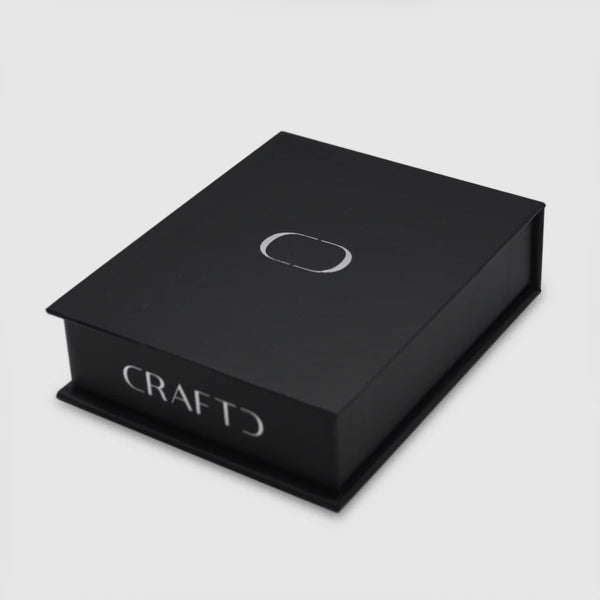
Coffret cadeau de luxe (€6,29)
Choose your option
À mon copain

À mon mari

À mon âme sœur

À mon fils

À mon petit-fils

À mon frère

À mon ami sincère

À mon papa

Un symbole de force

Un symbole de foi

Un symbole de protection

Un symbole de chance

Un symbole de voyage sûr

Un symbole de confiance en soi

Un Symbole d'Aventure
Article: How to Look After a Watch: Cleaning, Storage and Servicing
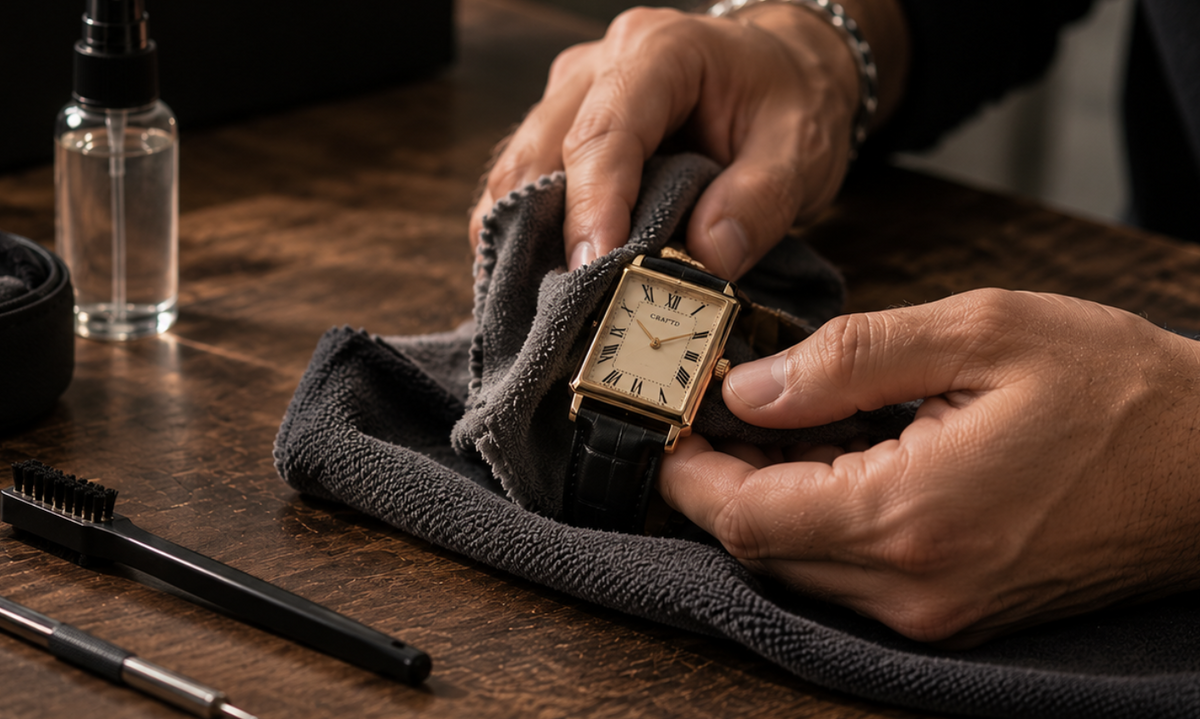
A watch can last for decades, and how well it ages has more to do with everyday habits than anything else. A regular wipe, a sensible place to keep it and a service when it needs one will keep the case bright, the glass clear and the time accurate.
This guide covers the small habits that protect a watch, how to clean each part, how to store it, and what to expect from batteries, winding and servicing.

A little care keeps the case, glass and strap looking this good for years. Featured: Square Signet Ring (Gold).
Jump to:
Most wear and tear happens in ordinary moments, so a few habits do most of the work.
Regular light cleaning is better than an occasional deep scrub.
If you need the basics, the Luxury Gift Box and Cleaning Cloth pairs a cloth for wiping down with a lined box for keeping pieces safe.
Dirt and skin oils build up between the links, which dulls the shine and can make the bracelet feel stiff. If your watch is water resistant, take it off and wash the bracelet in lukewarm, lightly soapy water, using a soft brush between the links. Rinse, then dry it thoroughly, including inside the clasp. If your watch isn't water resistant, clean the bracelet with a damp brush and keep the case dry.
Leather needs a different approach: no soaking, plenty of air and conditioning now and then. Our guide to black and brown leather watch straps covers how to keep one looking good.
Wearing bracelets next to your watch? They can rub against the case, so our guide to wearing a watch with bracelets explains how to space them.

Metal bracelets collect dirt between the links, so they deserve a deeper wash from time to time. Shop our silver jewellery.
Water resistance varies a lot from watch to watch, and the number on the case doesn't always mean what people assume. Our guide to choosing your first watch explains what the ratings actually mean.
Whatever the rating, a few rules apply to almost every watch:
Where a watch spends its time off the wrist has a big effect on how it ages.
The same rules apply to your chains and pendants. For chains in particular, see how to store necklaces.

Rest a watch flat or on its side, away from direct sun, when it's off your wrist.
A quartz watch runs on a battery, which often lasts a couple of years or more depending on the watch. Many quartz watches signal a low battery by moving the second hand in bigger jumps. Replace it promptly, as a dead battery left inside can leak and damage the movement. A watch repairer can change it and check the seals at the same time.
These run on a spring rather than a battery. A manual watch needs winding by hand, ideally as part of your morning routine. An automatic keeps itself wound through the motion of your wrist, but if you haven't worn it for a while, a few gentle turns of the crown will get it going again.
Mechanical watches generally benefit from a professional service every few years, and quartz watches need less attention. Follow the guidance that came with your watch, and book a check sooner if it starts gaining or losing noticeable time, the glass fogs, or the crown feels loose.
Your watch rarely goes out alone. Rings, chains and bracelets pick up the same dirt and knocks, so it makes sense to clean them on the same routine.
Matching metals keeps things simple too. If you're still deciding, read up on whether to choose a gold or silver watch.

Wipe rings and bracelets down at the same time as your watch. Featured: Inception Ring (Gold).
Wiping it down once a week is enough for most watches. Give a metal bracelet a deeper clean every month or two, or sooner after hot weather.
Only if it's water resistant and the crown is pushed fully in. Otherwise, use a cloth that's barely damp and keep moisture away from the crown and any buttons.
Light marks on a polished metal case can sometimes be softened with a polishing cloth, but deep scratches or marks on the glass are best left to a watch repairer.
It varies by watch, but often a couple of years or more. When the second hand starts jumping in bigger steps or the watch stops, it's time for a replacement.
Mechanical watches generally benefit from a service every few years, and quartz watches need less. Check the guidance that came with your watch, and get it looked at sooner if it starts gaining or losing time.
It's a good habit. It gives your skin and the strap a break, and a bedside table is a safer spot than your wrist while you sleep.
Looking after a watch isn't complicated. Wipe it often, give it a safe place to rest, respect its water rating, and get it serviced when it needs one. Do that, and it will keep looking and running like new.
To finish the look, browse our men's rings.
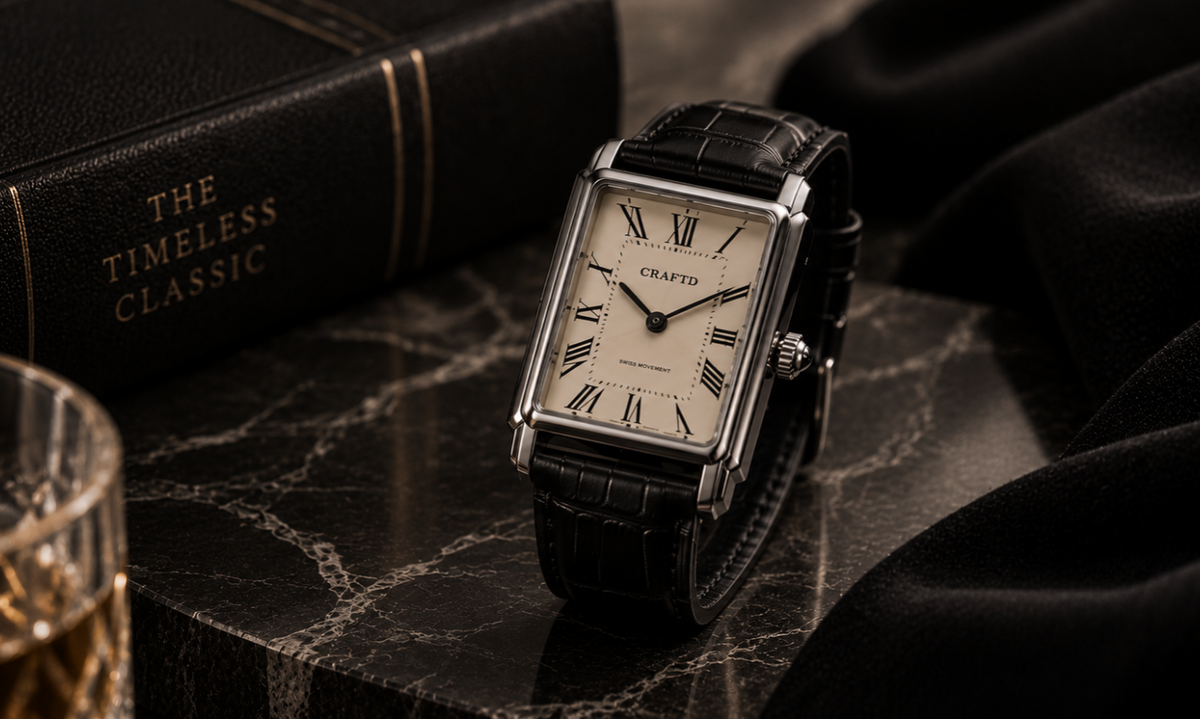
Roman Numeral Watches: Why the Classic Dial Still Works
A Roman numeral dial is one of the oldest looks in watchmaking, and it still feels right. Here’s where it comes from, the quirks to look for, and how to wear one well.
En savoir plus
 Ready to give.
 Hand-finished chains.
 Pendants with meaning.
 Neck and wrist, done.
 The clover collection.
 Créez votre propre ensemble (argent)
 Créez votre propre ensemble (or)
 Crucifix (Argent)
 Crucifix (Or)

Laisser un commentaire
Ce site est protégé par hCaptcha, et la Politique de confidentialité et les Conditions de service de hCaptcha s’appliquent.