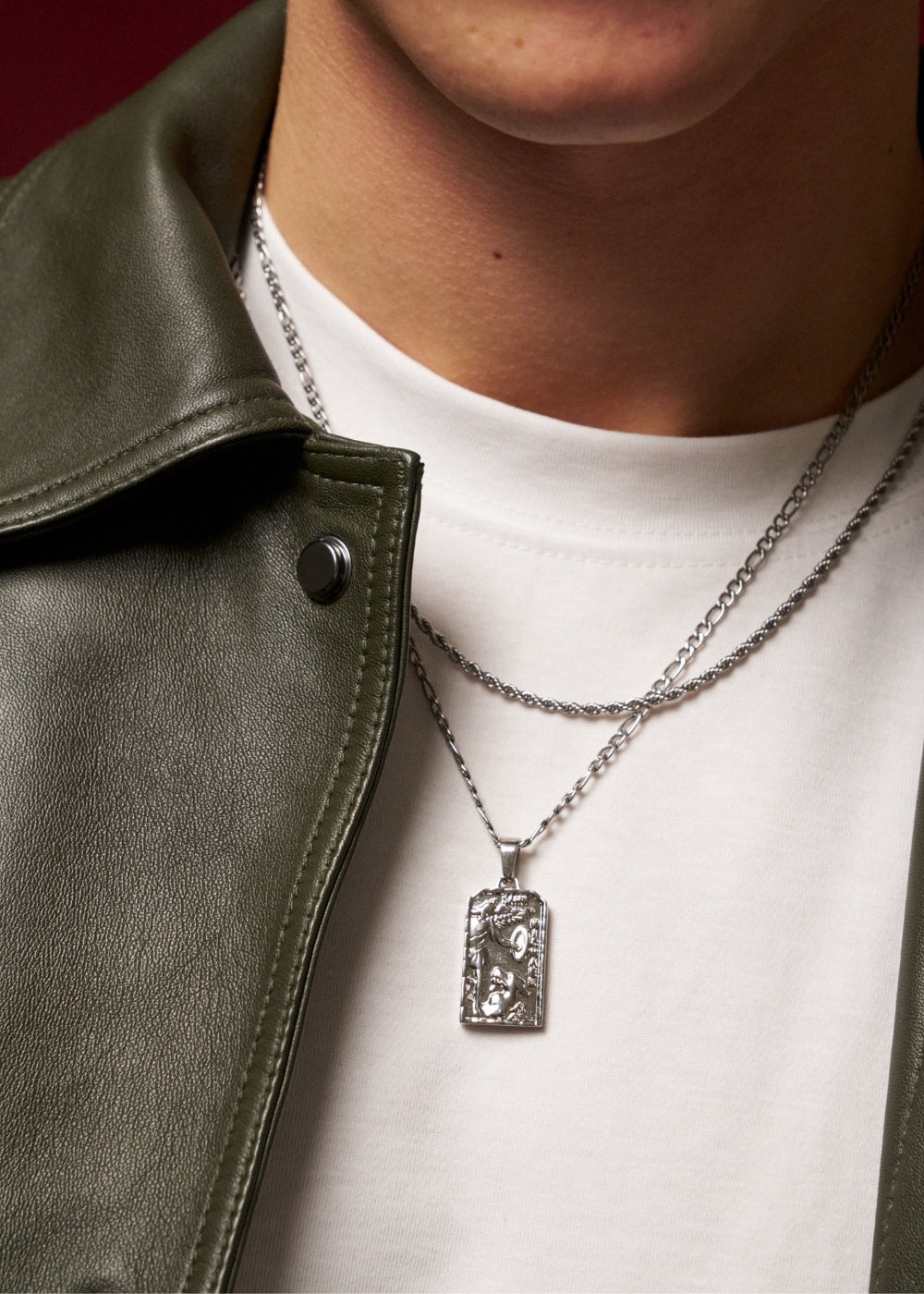
COLLANE D'ARGENTO
ACQUISTA ORA



Before you test anything, it helps to know what you're testing for. "Is it real gold?" usually means "is it solid gold?", and those aren't the same question. Gold-plated jewellery is real gold on the surface. Gold vermeil is real gold over real silver. Neither is solid gold, and neither is fake.
So this guide does two jobs. It shows you how to tell solid gold from plated gold, and plated gold from the cheap gold-tone pieces that contain almost none at all. It covers the stamps, seven home tests and which of them to trust, what the tests can't tell you, and exactly what gold we use.

Real gold, solid gold and gold plated aren't the same thing. Featured: the 2mm Connell chain in gold.
Jump to:
People ask us this a lot, so here's the complete answer rather than a comfortable one.
Our gold is real 18K gold, used as a finish rather than solid all the way through. It comes in two constructions:

Real 18K gold over a solid 316L stainless steel core. Featured: the North Star pendant.
Neither is solid gold, and we don't describe either as solid gold. The quickest way to check any piece of ours: open the product page and read the Our Materials section. It names the metal outright. Our guide to 18K gold vs gold vermeil explains how each is built and why the base metal matters more than the karat number.
| Type | What it is | Real gold? |
|---|---|---|
| Solid gold | Gold alloyed with other metals all the way through, usually 9K to 22K | Yes, throughout |
| Gold vermeil | A thick layer of gold, at least 2.5 microns, over sterling silver | Yes, on the surface, over a precious metal |
| Gold plated | A layer of gold bonded over another metal, often brass, copper or steel | Yes, on the surface |
| Gold-filled | A thicker sheet of gold bonded to a base metal | Yes, on the surface |
| Gold-tone | Gold-coloured metal or coating with little or no gold in it | Usually no |
Most of the tests below are good at one thing: telling solid gold from everything else. They're much less good at telling a well-made plated piece from a cheap one. For that, the base metal is what matters, and our guide to what gold plated actually means goes through it.
Solid gold is usually stamped with its purity, somewhere small: inside a ring band, on the clasp, or on the tag beside it. There are two systems, and they mean the same thing.

The clasp and end ring are where stamps sit, and where plating wears first. Featured: the 3mm Rope chain.
Other marks tell you it isn't solid:
A stamp is a strong starting point, but it's a claim rather than a test. Anyone can stamp a number on a clasp. Our guide on what 925 means on jewellery covers the marks in more detail, including the stamps that look official and aren't.

On a ring, look for the mark inside the band. Featured: the Square Signet Ring.
Gold isn't magnetic. Hold a strong magnet to the piece, and a solid gold chain won't move. If it pulls, there's a magnetic metal inside, usually under plating. Test the links rather than the clasp, because the spring inside a clasp can be steel even on solid gold. This is excellent for ruling solid gold out, and useless for confirming it, because plenty of non-magnetic metals aren't gold.
Look closely at the clasp, the edges and anywhere that takes constant contact. On plated jewellery, that's where the gold thins first, and you'll see a different colour underneath: brassy, coppery or silver. Solid gold is the same colour all the way through, however worn it gets.
Wear the piece for a day or two. Green or black marks on your skin usually mean copper in the base metal reacting with sweat. High-karat solid gold doesn't do this. Low-karat gold occasionally can, so treat a mark as a strong hint rather than proof.

A tarnished or green-marking piece tells you about the base, not the gold. Featured: the Crucifix pendant.
Gold doesn't tarnish, so a piece that has darkened, gone dull in patches or changed colour is showing you its base metal. Our guide to does gold tarnish explains what's happening under the surface of each type.
Gold is very dense, so a solid gold chain feels noticeably heavy for its size. This only works if you have a piece you're sure of to compare against, but if you do, it becomes a useful reference.
Drag the piece across the unglazed underside of a ceramic tile or mug. Real gold leaves a gold streak. A black streak points to something else. It works, but it scratches the piece, so only try it somewhere hidden, and never on plated or vermeil jewellery, where it will take the gold layer off.
The most shared test online, and the least useful. Real gold won't react to vinegar, but neither will a lot of plated jewellery, so a pass proves very little. If the metal changes colour, it isn't solid gold. If it doesn't, you've learned almost nothing. The float test has the same problem: gold sinks, but so does every other metal.

Skip the home tests on anything set with stones. Featured: the 3mm Tennis chain.
Anything set with stones is best left out of home testing altogether. Vinegar, scrubbing and scratch tests can dull or loosen a setting.
| Test | What solid gold does | How much to trust it |
|---|---|---|
| Stamp | Carries a karat or number such as 18K or 750 | High as a starting point. A stamp is a claim, not a test |
| Magnet | Isn't attracted at all | High for ruling solid gold out. It won't confirm it |
| Wear points | Same colour all the way through | High on a piece you've worn for a while |
| Skin | Leaves no mark | Moderate. Low-karat gold can occasionally mark |
| Tarnish | Never tarnishes | Good. Tarnish means a base metal is showing |
| Weight | Feels heavy for its size | Moderate, and only with something to compare |
| Ceramic streak | Leaves a gold streak | Good, but it scratches the piece |
| Vinegar or float | No reaction, sinks | Low. Plenty of fakes pass too |
Two honest limits, because most articles on this leave them out.
None of them measure purity. They can tell you something is solid gold rather than plated. They can't tell you it's 18K rather than 14K. Only a jeweller's acid test or an XRF scanner does that.
And good plating passes most of them. A thick gold layer over a non-magnetic base can pass the magnet test, leave no mark on your skin and never tarnish. That's the point of a well-made plated piece, and it's why the base metal and the thickness of the gold matter far more than any home test. For how long a plated finish lasts, see how long gold-plated jewellery lasts.

Gold vermeil carries the 925 mark of the silver underneath. Featured: the 3mm Wheat chain in 18ct gold vermeil.
For anything you've spent real money on, or anything you're thinking of selling, a jeweller's test is worth the appointment. There are two main methods:
Both can tell 14K from 18K, which no home test can.
Start with the stamp: a karat mark such as 14K or 18K, or a number such as 585 or 750, points to solid gold. Then try a magnet, which real gold ignores, and check the clasp and edges for a different colour showing through. Those three together rule most fakes out. Only a jeweller's acid or XRF test confirms purity.
Our gold is real 18K gold, used as a finish rather than solid all the way through. Most of our gold pieces are real 18K gold over a solid 316L stainless steel core. Our gold vermeil is 18ct gold over solid sterling silver. Every product page names the metal in its Our Materials section.
No. Gold isn't magnetic, so a real solid gold piece won't pull towards a magnet at all. If it does, there's a magnetic metal inside, usually under plating. Test the links rather than the clasp, because the spring inside a clasp can be steel even on solid gold.
High-karat solid gold doesn't. Green marks come from copper, either in a copper-rich base metal under worn plating or, occasionally, in a low-karat alloy. A piece that marks your skin green after a short time is usually plated over brass or copper.
They're parts per thousand of pure gold. 417 is 10K, 585 is 14K, 750 is 18K, 916 is 22K and 999 is 24K. Marks such as GP, GEP, HGE or RGP mean gold plated rather than solid gold, and a gold piece stamped 925 is gold vermeil over sterling silver.
Not reliably. Real gold won't react to vinegar, but neither will plenty of plated pieces, so a pass proves very little. It can tell you a piece is fake if it changes colour, but it can't tell you it's real.
The surface is. Gold plating is a real layer of gold over another metal, so it's real gold, but not solid gold. How long it lasts depends on how thick the gold is and what's underneath it, which matters far more than the karat of the plating.
With an acid test, which checks how the metal reacts to acids of known strength on a testing stone, or with an XRF scanner, which reads the metal's make-up without touching it. Both can tell 14K from 18K, which no home test can. For anything valuable, it's worth the appointment.
Start with the stamp, rule solid gold in or out with a magnet and a look at the wear points, and take anything valuable to a jeweller. And remember that real gold and solid gold aren't the same thing: what sits under the gold decides how a piece wears.

The quickest check on any of our pieces: read the materials on the product page. Featured: the 3mm Figaro chain.
For silver, our guide on how to tell if silver is real runs the same checks. For the wider picture, see the different types of gold, or browse our men's gold chains and gold vermeil collection.

Does Gold Tarnish? Solid, Plated and Vermeil Gold Explained
Pure gold doesn't tarnish, so why does so much gold jewellery fade? Here's what's really happening with solid, plated and vermeil gold, how to tell which you own, and how to keep it bright.
Per saperne di più
Conor McGregor's Necklace: The Story Behind the Crowned Lion
Conor McGregor wore a lion pendant for years, so our founder made him a custom, engraved solid gold one. Here's the story behind his crowned lion necklace, what it means, and what he wears now.
Per saperne di più


Commenta
Questo sito è protetto da hCaptcha e applica le Norme sulla privacy e i Termini di servizio di hCaptcha.